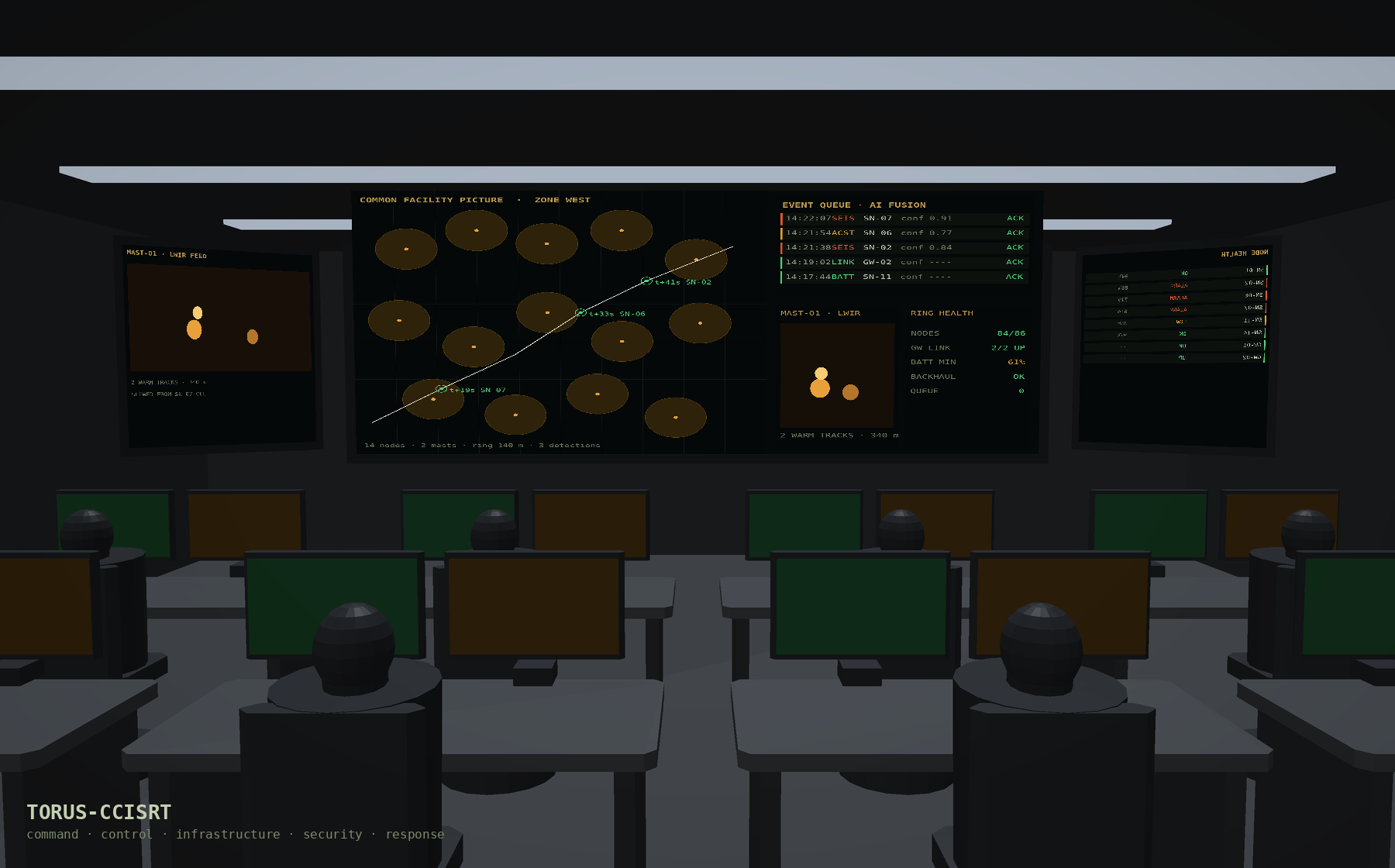
TORUS-CCISRT turns a facility sensor network into an operations decision. It ingests prioritised event streams from every TORUS-MEG gateway, fuses them into a single geospatial common operating picture, and presents that picture to the operations room and the facility team at once. Both see the same live state; each sees it in the form their job needs.
Unlike the rest of the TORUS datasheet suite, CCISRT is not concept-only. A runnable
reference application exists in the torus-ccisrt repository and is verified
end to end by 43 automated checks. It implements the event schema, node roster,
transducer interlock, capability-based login, a live web console with map, alarm meter,
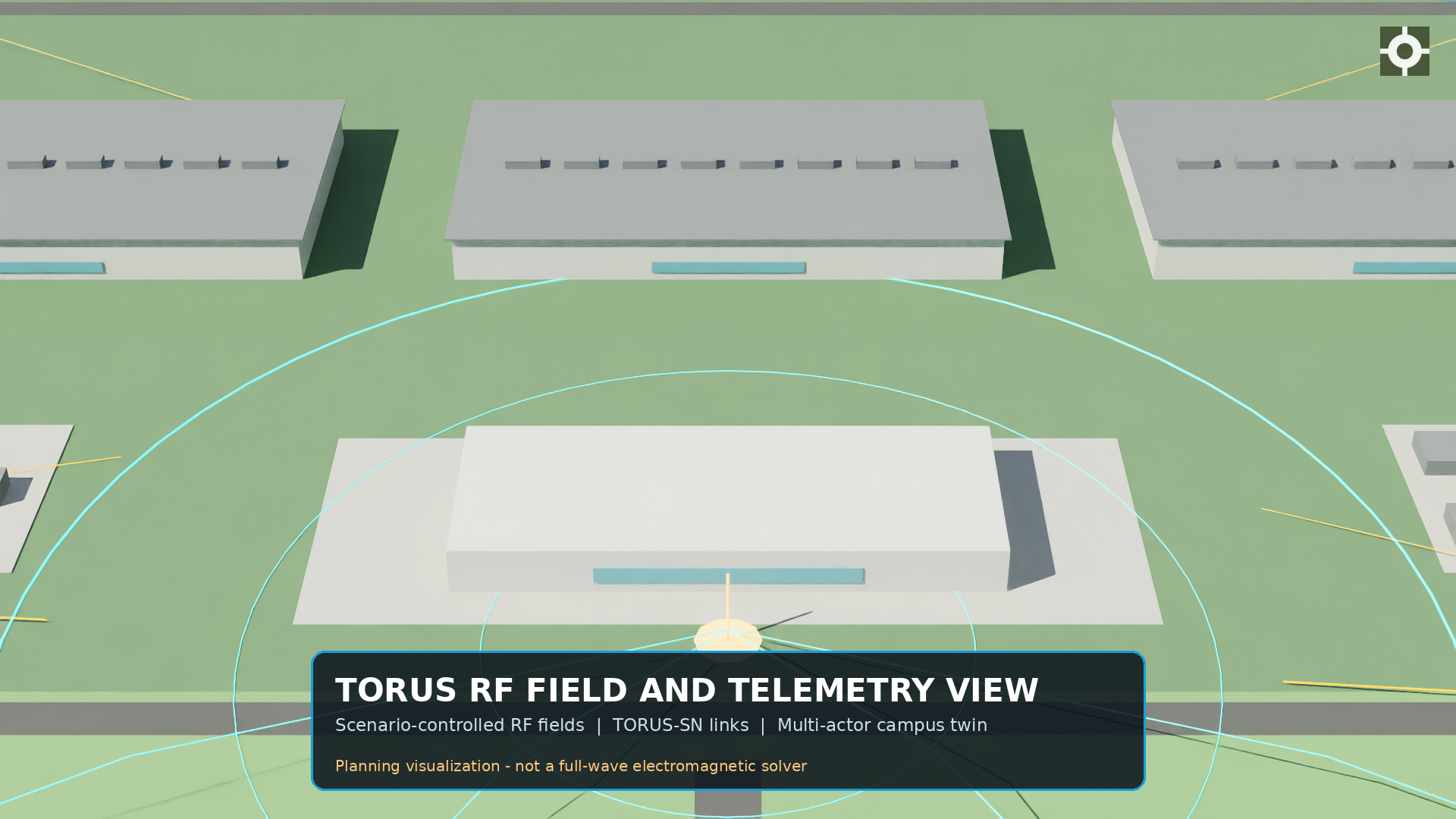
security-event radar and Isaac scenario view, OpenTelemetry telemetry, and a controllable
facility simulator.
One live state, two vantage points. The room and the field never argue about what is happening.
Rule-based and explainable today, with a learned-model interface already defined for phase 3.
Transducer actuation behind a safety interlock. Arm, safety-validate, then trigger, with every action audited.
Coordinate and plan. Browser-based, with an Electron desktop shell.
Act on site. Rugged tasking app, React Native packaging on the roadmap.
Every layer speaks the same event contract, so a site can mix node classes and backhaul without changing the command layer.
TORUS-SN node ring, SN-TIR visual masts and drone or UAS sensing. Seismic and acoustic in the ground, thermal and LiDAR at eye level, RF detection overhead.
LoRa at 433 MHz carries compact labelled events with per-source sequence numbers into TORUS-MEG gateways for edge fusion, store and forward, and GNSS-disciplined timestamps.
Ethernet, cellular or SATCOM carries the prioritised stream, and reconciles on rejoin so nothing is lost when a link drops.
Event bus, fusion and correlation, geospatial engine, timeline and event store, node and gateway registry, alert policy engine, auth and RBAC, API and integrations.
Operations-room video wall and workstations, and rugged tablets or handhelds for the facility team.
REST API, webhooks and OpenTelemetry push tracks and metrics to PSIM, DCIM, BMS, VMS and SIEM systems, with Redfish, BACnet, ONVIF and MQTT adapters.

A role is a set of capabilities, not a linear rank, and the machine role is distinct from the operator roles.
On-premises, private cloud or Azure Container Apps from the provided container image, with an offline option for controlled AI/HPC data center environments.
Capability-based RBAC, interactive login, encrypted transport, signed updates and a full audit log.
Store and forward at the gateway, and a facility app that degrades gracefully when it goes offline.
For evaluation. Specifications are preliminary and subject to change without notice. The full engineering record is in the TORUS-CCISRT datasheet.
The console is a zero-dependency core by design. The server and the web client need nothing but Node.js, and every browser library is vendored locally rather than loaded from a CDN, so the whole console stays auditable and runs in an air-gapped facility.
Base map for the geospatial picture, vendored locally
Scenario view of the deployment twin from
Isaac Sim
Node.js, Electron, Leaflet, OpenStreetMap, OpenTelemetry, NVIDIA and Isaac Sim, and their logos, are trademarks of their respective owners. They are shown to indicate the technologies TORUS-CCISRT builds on and interoperates with. TORUS-CCISRT is not affiliated with, sponsored by or endorsed by these projects or companies. Node.js is a trademark of the OpenJS Foundation. OpenStreetMap is a trademark of the OpenStreetMap Foundation and its map data is licensed under the Open Database License. OpenTelemetry is a project of the Cloud Native Computing Foundation. The NVIDIA logo is reproduced unaltered from NVIDIA's logo and brand usage page.
The console runs against a controllable facility simulator, so an evaluation shows the full event path, from a ground node detection through gateway fusion to the alert queue and the transducer interlock, without a single sensor in the ground.