TORUS-CCISRT command layer
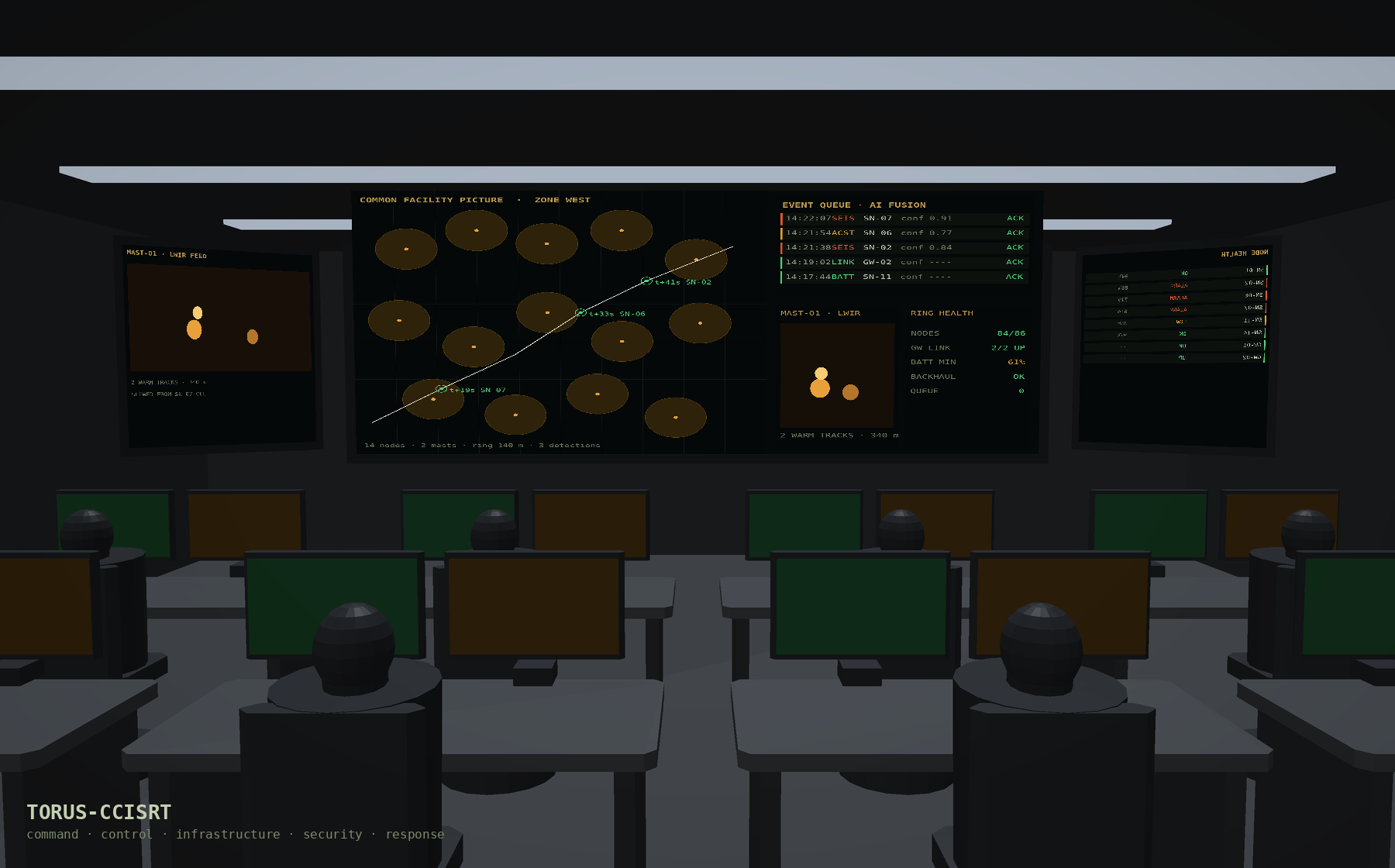
TORUS-CCISRT turns a facility sensor network into an operations decision. It ingests prioritised event streams from every TORUS-MEG gateway, fuses them into a single geospatial common operating picture, and presents that picture to the operations room and facility teams at once. Both see the same live state; each sees it in the form their job needs.
MEG gateway AI/ML engine Deployment rehearsal
01 · Implementation status
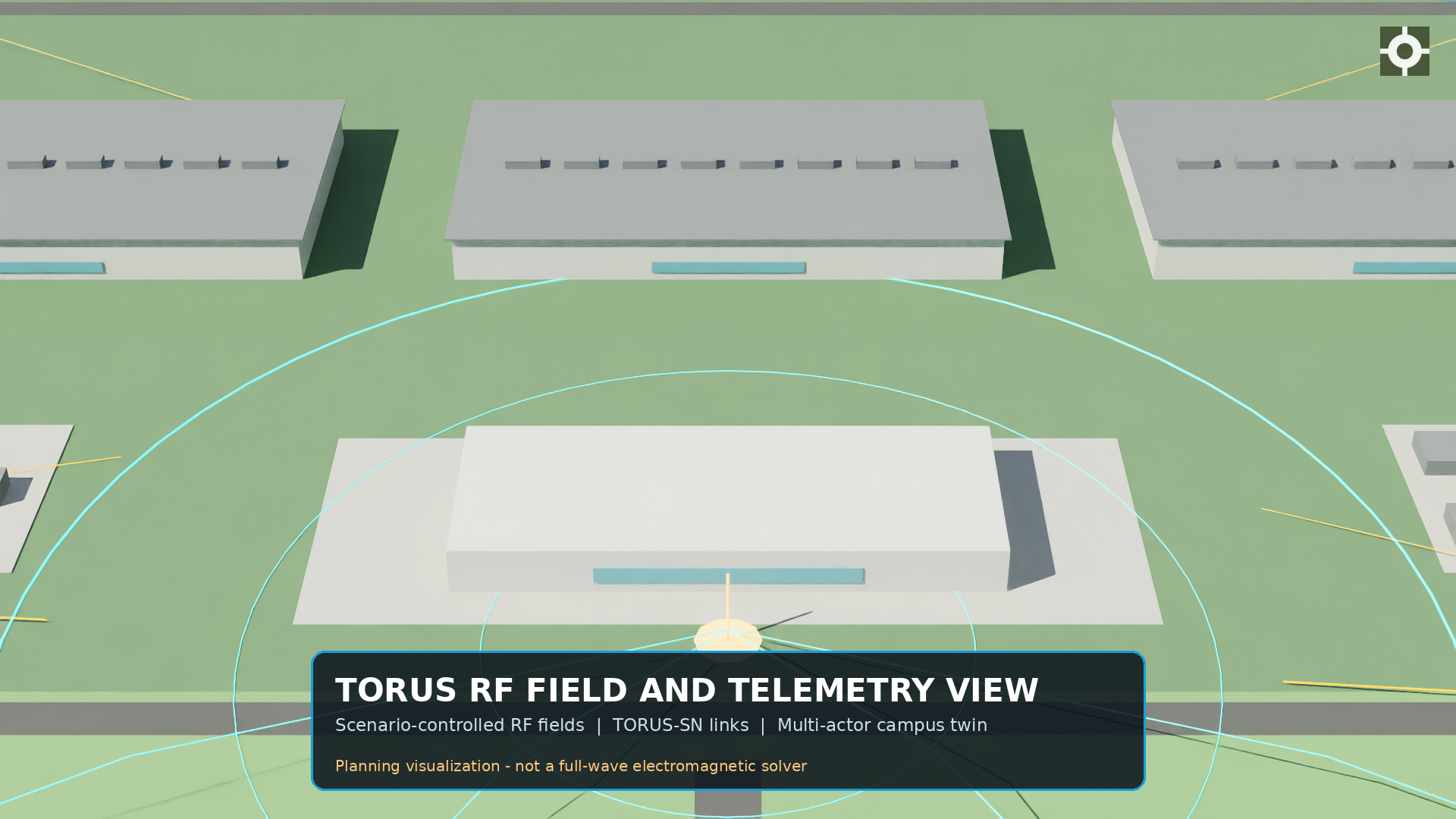
The same environment is used before deployment and during it. Data center facilities are rehearsed as digital twins in NVIDIA Isaac Sim, and the validated plan of node positions, gains, and alert policies is promoted straight into the live CCISRT picture.
Implementation status · runnable
Unlike the rest of this datasheet suite, TORUS-CCISRT is not concept-only. A
runnable reference application exists in the torus-ccisrt repository and is
verified end-to-end by 43 automated checks. It implements the event schema,
node roster, transducer interlock, capability-based login, a live web console
with map, alarm meter, security-event radar, and Isaac scenario view,
OpenTelemetry telemetry, and a controllable facility simulator.
The fusion and correlation core ships as an explainable rule-based engine today, with a learned-model interface defined for phase 3. Production hardening (real identity provider, database backend, packaged desktop and mobile installers) remains open work.
02 · Two operator vantage points
| Vantage point | Picture | Capabilities | Packaging |
|---|---|---|---|
| Operations room · coordinate and plan | Common operating picture | Map and GIS wall with live node, gateway, and mast state. Fused alerts with class, confidence, and location. Triage and prioritisation queue with acknowledge and escalate. Thermal and video tiles cued from the visual masts. Timeline scrub and forensic replay of any event. Deployment planning and Isaac Sim rehearsal link. Node health, battery, and link dashboards. Multi-operator collaboration with role-based views. | Browser-based; Electron desktop shell. |
| Facility team · act on site | Rugged tasking app | Handheld or tablet map with own position, node ring, and data hall zones. Prioritised push alerts with bearing and distance. Cue a sensor or mast and request a snapshot on demand. Confirm, dismiss, or reclassify an event on site. Offline-tolerant sync over the gateway or mesh. Shared picture with the room in near real time. | Roadmap: React Native packaging. |
03 · Common operating picture and planning
CCISRT provides a map and GIS wall with live node, gateway, and mast state; fused alerts with class, confidence, and location; node health, battery, and link dashboards; and an Isaac Sim rehearsal link. The validated plan of node positions, gains, and alert policies is promoted straight into the live CCISRT picture.
04 · Alert triage and event flow
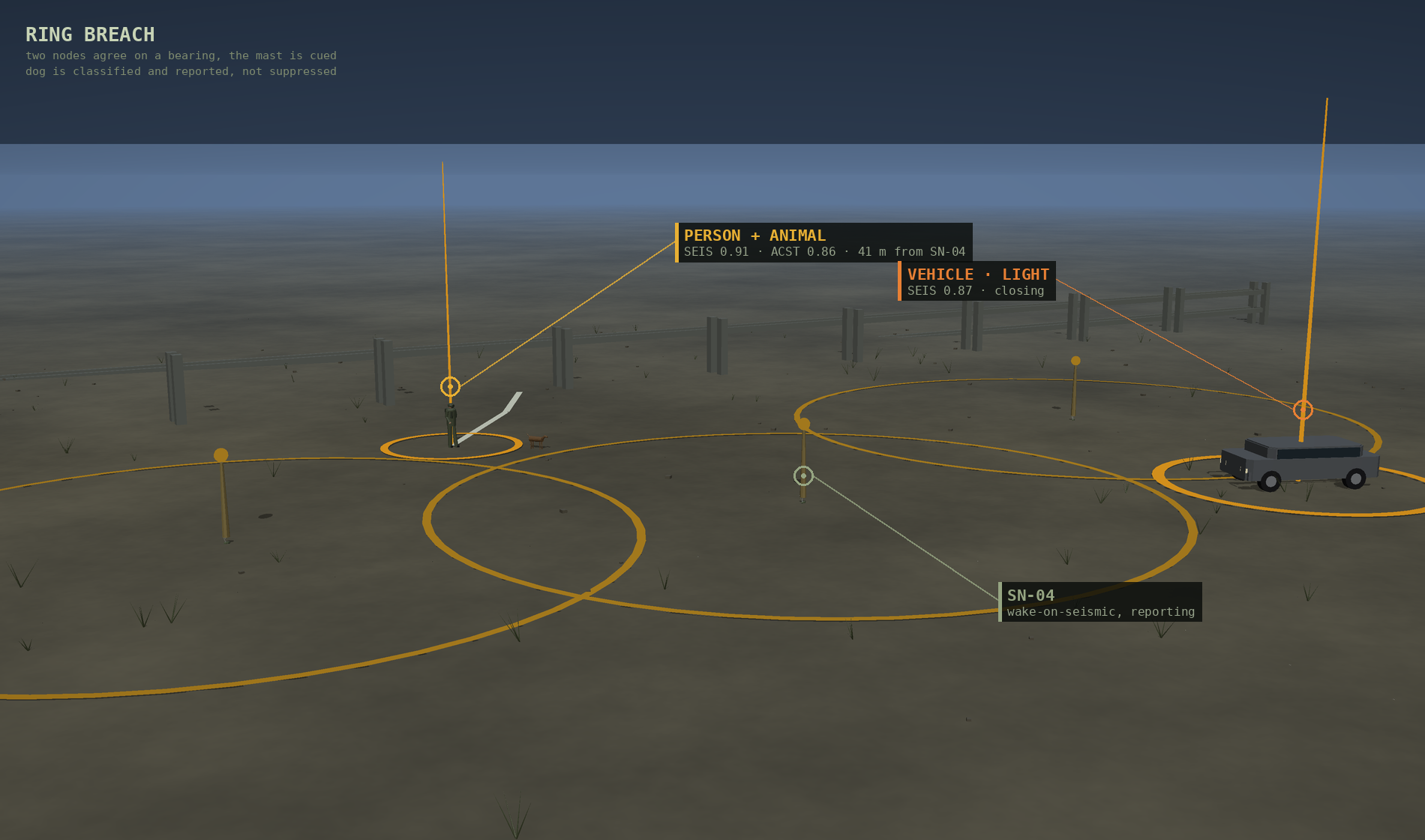
The operations room receives fused alerts with class, confidence, and location, uses a triage and prioritisation queue with acknowledge and escalate, and can scrub the timeline for forensic replay of any event. Facility teams receive prioritised push alerts with bearing and distance, can cue a sensor or mast and request a snapshot, and can confirm, dismiss, or reclassify an event on site.
05 · Control-plane architecture
| Layer | Element | Role |
|---|---|---|
| Facility layer | TORUS-SN node ring · visual masts · drone/UAS sensing | Seismic and acoustic ground nodes; thermal and LiDAR masts; RF drone detection (R&D). |
| Uplink | LoRa 433 MHz | Compact labelled events and per-source sequence numbers. |
| Aggregation | TORUS-MEG gateways | Edge fusion, store and forward, and GNSS-disciplined timestamps. |
| Backhaul | Ethernet / cellular / SATCOM | Prioritised stream; reconciles on rejoin. |
| TORUS-CCISRT core | Event bus · fusion and correlation · geospatial engine | Timeline and event store, node and gateway registry, alert policy engine, auth / RBAC, API and integrations. |
| Clients | Room and facility team | Video wall and workstations; rugged tablet / handheld. |
06 · Capabilities
| Area | Capability |
|---|---|
| Infrastructure | Live common operating picture; node and mast state; thermal and video tiles cued by facility events. |
| Detection | Fusion of seismic, acoustic, and roadmap visual and drone cues into single tracks with confidence. |
| Security | On-demand sensor cueing, snapshot requests, and mast slew-to-cue from the operations room or facility teams. |
| Response | Timeline, forensic replay, post-incident review, and event history across the deployment. |
| Control | Node configuration, gain and threshold policy, alert rules, arm and disarm zones, BKC firmware upgrade and downgrade. |
| Transducer | Facility response actuation under safety interlock, from arm to safety-validate to trigger; trigger refused until validation passes; every action audited. |
| Tier | TIA-942 and OCP-aligned deployment planning in Isaac Sim; promote the validated plan to the live picture. |
| Collaboration | Multi-operator, role-based access, shared annotations, hand-off between room and facility team. |
| Integration | Northbound REST API, webhooks, and OpenTelemetry to push tracks and metrics to PSIM, DCIM, BMS, VMS, and SIEM systems, with Redfish, BACnet, ONVIF, and MQTT adapters. |
07 · Roles and capabilities
Access is capability-based. A role is a set of capabilities, not a linear rank, and the machine role is distinct from operator roles.
| Role | Capabilities |
|---|---|
viewer |
View the common operating picture, read-only. |
field-operator |
View plus cue sensors and masts from the facility. |
operator |
View plus cue plus command: transducer interlock, node enable, disable, sync. |
analyst |
View plus data and telemetry, read-only, no command capability. |
admin |
View, cue, command, telemetry, audit log, and manage. |
root |
Full access to all capabilities; development default account. |
gateway |
Machine role to ingest events and write telemetry. |
08 · Deployment and platform
| Aspect | Approach |
|---|---|
| Hosting | On-premises, private cloud, or Azure Container Apps with a container image provided; offline option for controlled AI/HPC data center environments. |
| Display system | Operations-room video wall plus operator workstations; browser-based clients, desktop via Electron. |
| Facility clients | Rugged tablets and handhelds (roadmap: React Native); interoperable with PSIM, DCIM, BMS, and VMS workflows through the northbound API. |
| Security | Capability-based RBAC, interactive login, encrypted transport, signed updates, full audit log. |
| Maps | Configurable basemap (OpenStreetMap, Mapbox, Google, or fully offline tiles) for controlled facilities; optional campus imagery layer. |
| Resilience | Store-and-forward at the gateway; the facility app degrades gracefully when offline. |