Unattended Air-Ground-Visual Sensing for AI/HPC data centers
TORUS is a UAGVIS platform: Unattended Air-Ground-Visual Sensing. It extends the unattended ground sensor (UGS) model that perimeter security has relied on for decades into the two domains a data center campus also has to cover, eye level and the air above it. Seismic and acoustic sensing in the ground, thermal and LiDAR confirmation at eye level, and drone/UAS detection overhead, classified at the edge with on-device AI and driving facility response actuation under safety interlock where remote power or network access is limited.
TORUS-SN ground node Power calculator Deployment rehearsal
01 · The perimeter is the problem
AI/HPC data center facilities need continuous awareness across campus perimeters, service yards, data hall approaches, substations, and cooling plant areas. These zones often have constrained power, network, and staffing. Fixed cameras see a cone; guard rounds see a moment; fences report only contact.
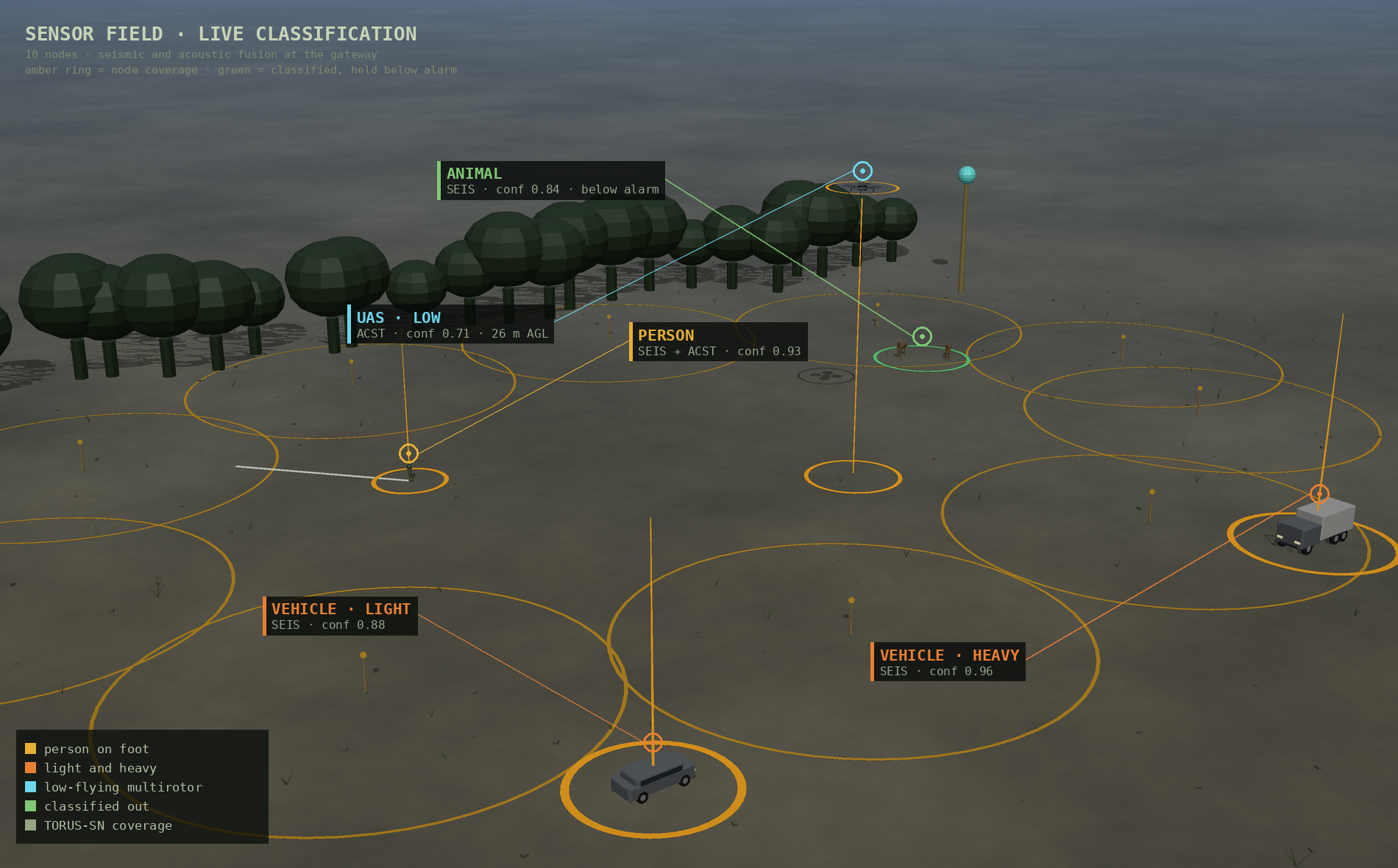
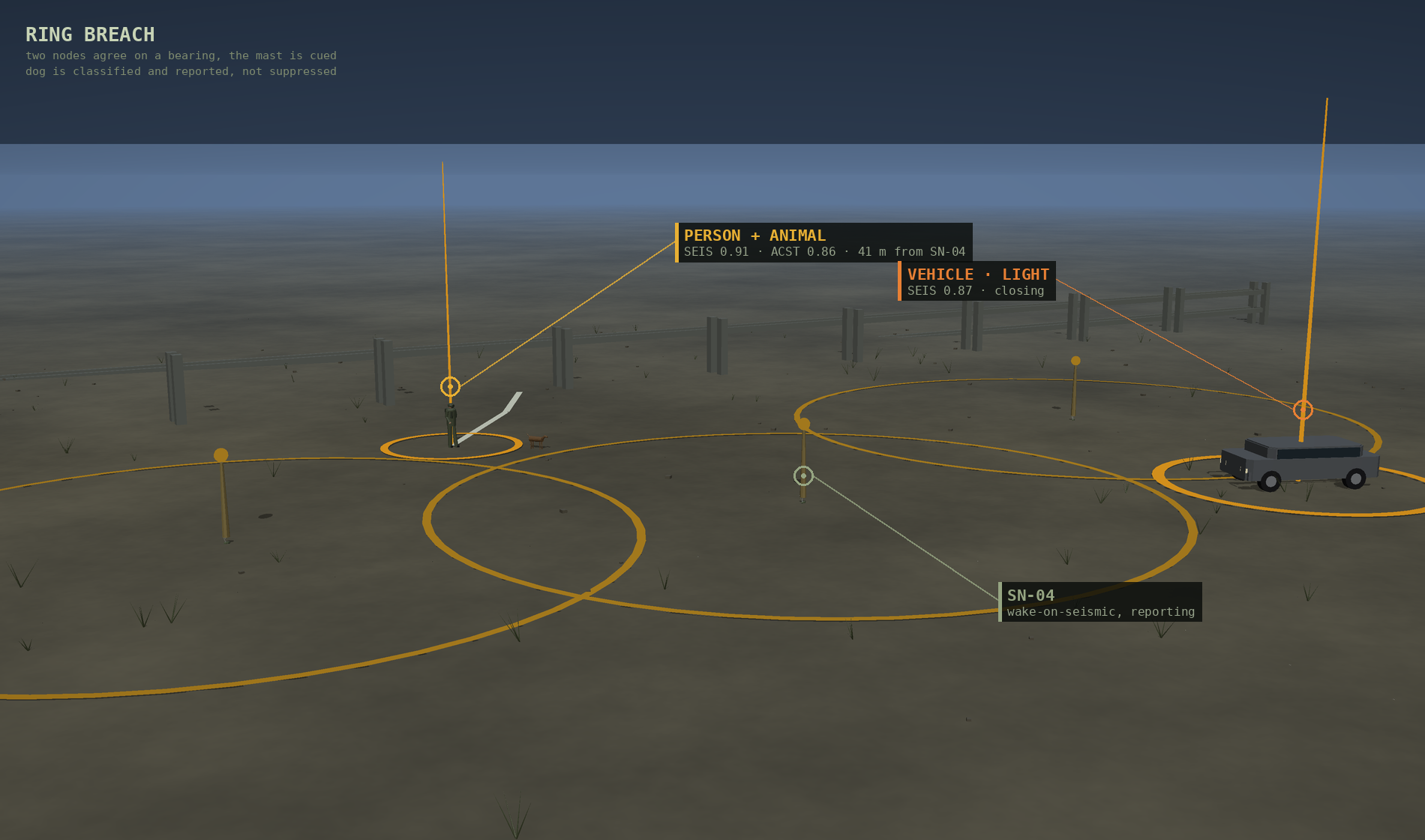
TORUS monitors those approaches continuously and passively. It detects intrusion in more than one physical domain, correlates the cues, and gives operators a validated track with location and confidence, not a raw alarm. PacketFive Design Services can adapt TORUS for other customer requirements.
| Property | Detail |
|---|---|
| Design goal | No event is missed. Every security event is captured, sequenced, and delivered. Coverage gaps are detected, not discovered after the fact. |
| Posture | Passive and low-signature sensing emits nothing to find. The only active element is a response node, and it actuates only through an interlock. |
| Autonomy | Facility-ready unattended operation covers primary-cell and solar operation, long-range radio, and years between visits. |
| Assurance | Auditable by design. Every detection and every command is timestamped and logged for post-incident review. |
02 · The three domains in UAGVIS
The acronym is the architecture. TORUS covers campus perimeter and facility approaches from below, at eye level, and overhead. Each domain matures on its own track, so the ground layer deploys today and the system extends without replacing installed assets.
| Domain | Status | Detail |
|---|---|---|
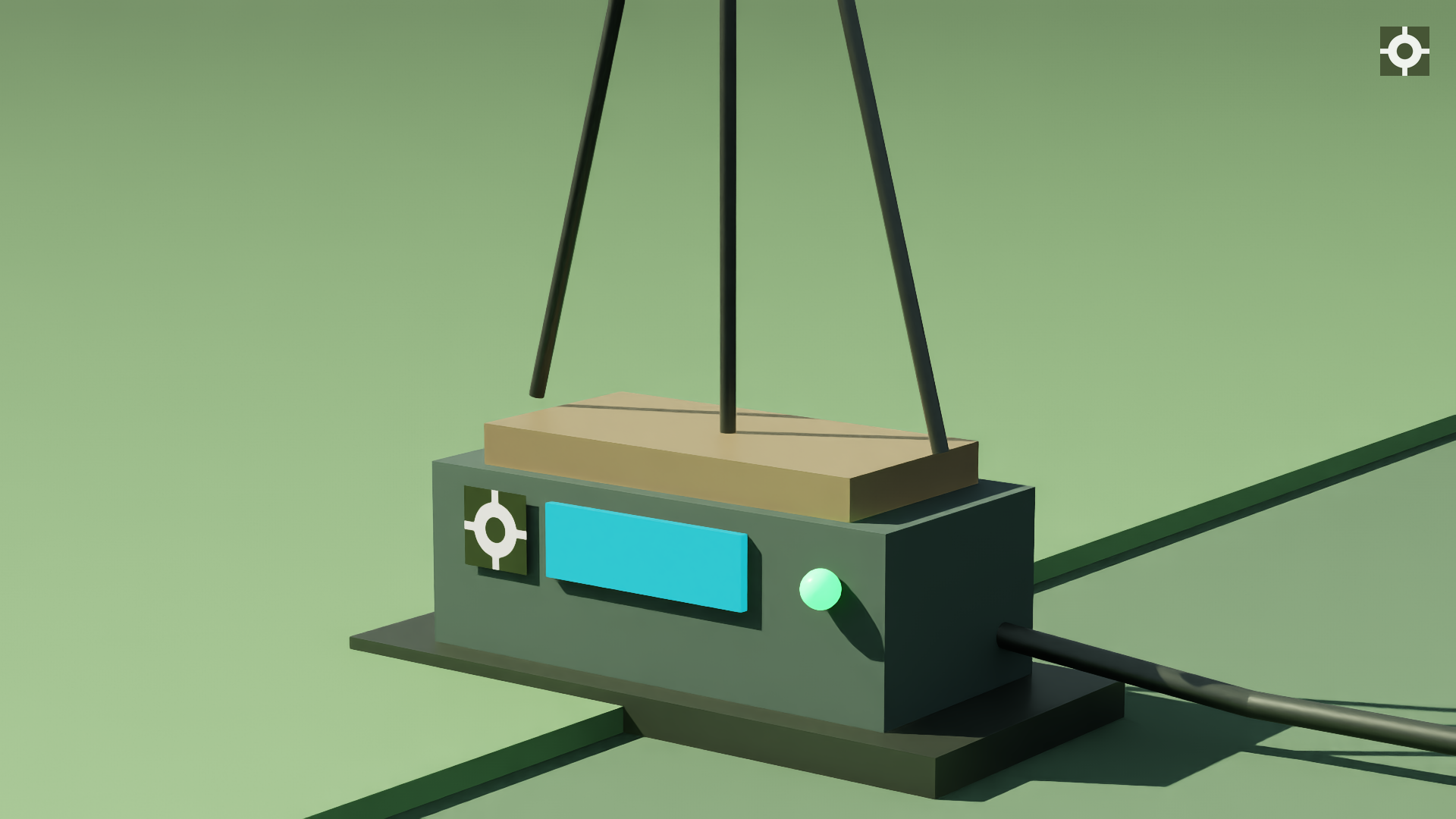
| Ground | Fielded | Seismic and acoustic detection on unattended primary-cell nodes reporting over long-range radio. Pre-production hardware complete; next-design baseline set. TORUS-SN |
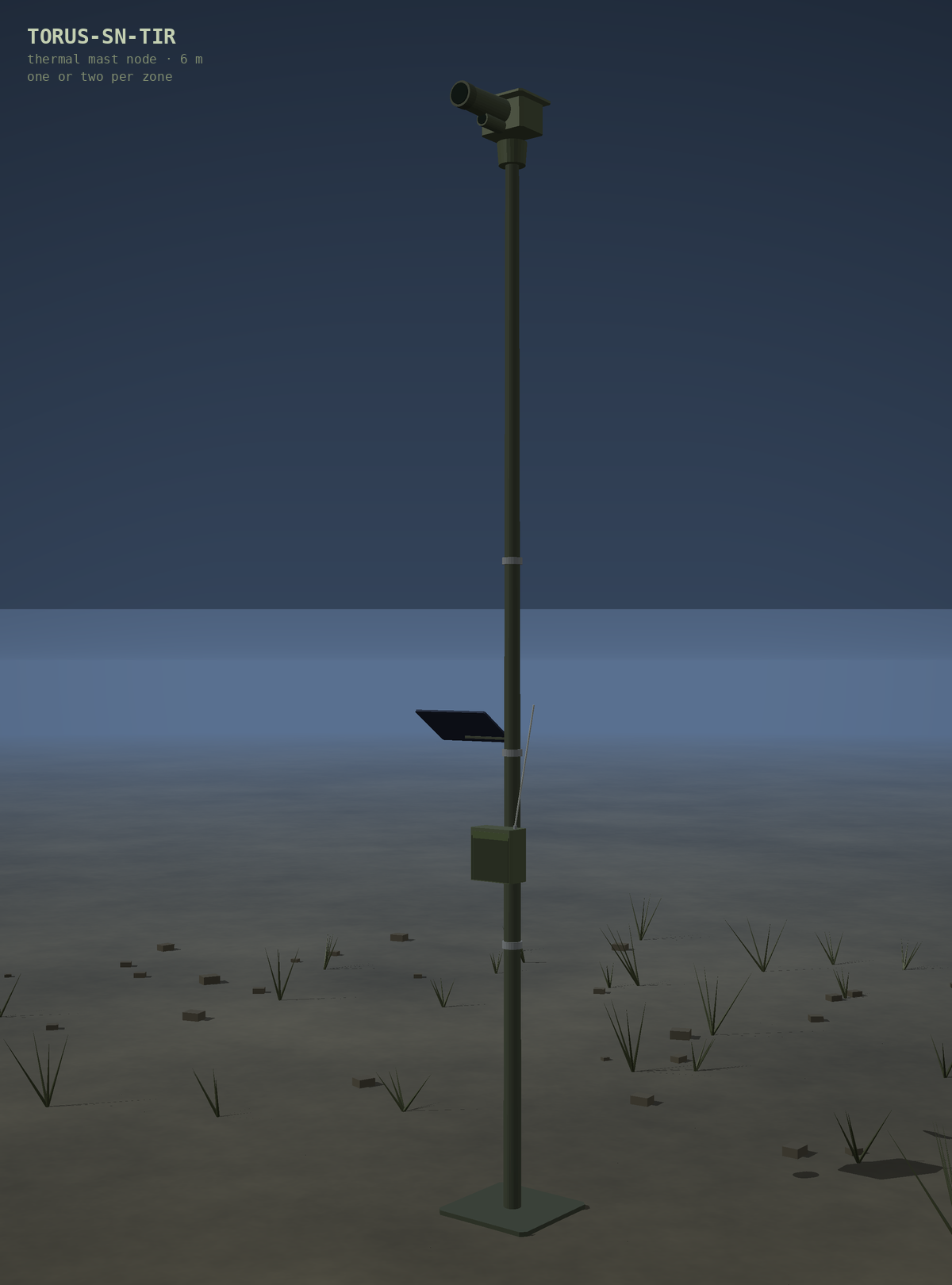
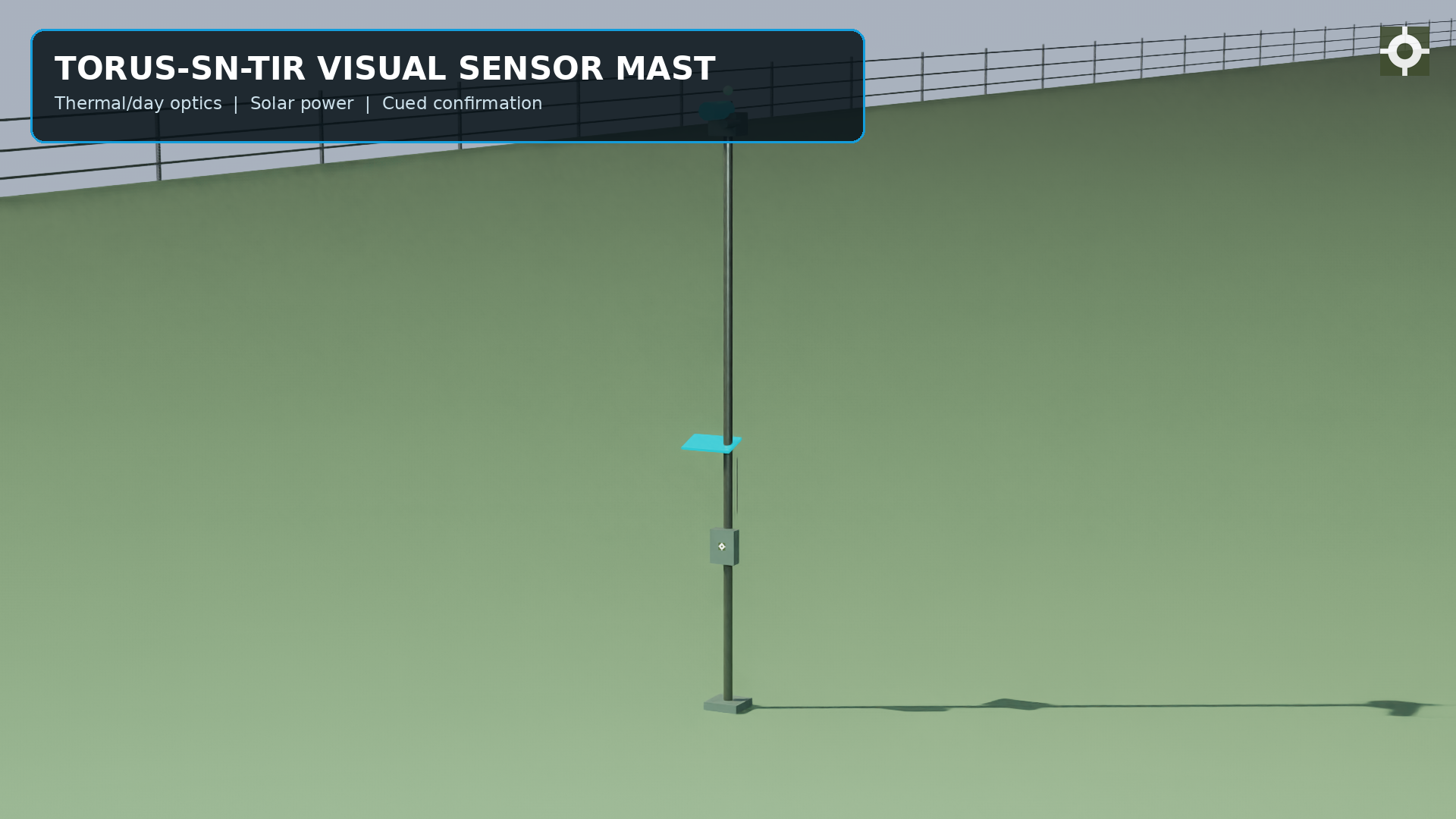
| Visual | In development | Long-range thermal cores and LiDAR on a mast, cued by ground detections to identify and track at standoff, day or night. Thermal LWIR + LiDAR + long-range optics. |
| Air (drone / UAS) | R&D | Radar-class RF detection of drones and UAS over the facility. An active research track: long-range drone detection demands higher transmit power and dedicated RF front ends. |
03 · One protocol, four node classes
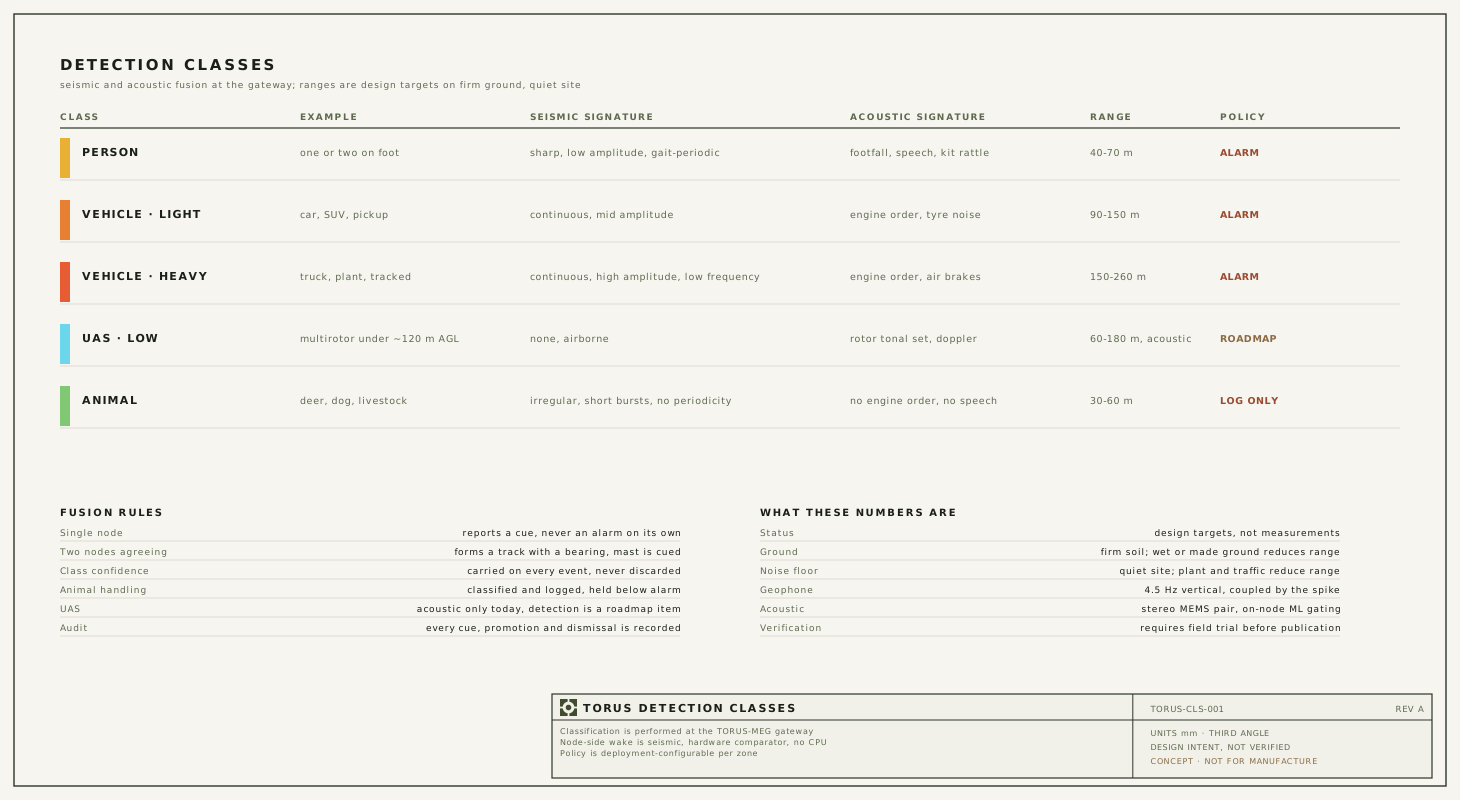
A deployment mixes node classes to match cost, alarm profile, and facility constraints. All classes report on the same event contract, so the CCISRT layer treats a mixed facility field as one sensor network.
| # | Class | Link / RF | Maturity | Role and trade-off |
|---|---|---|---|---|
| 1 | Fixed Wireless | LoRa 433 MHz | Fielded | Lowest cost per node; the default perimeter element for wide, dense rings. |
| 2 | Programmable Wireless | SDR (AD9371 / AD9363) + LoRa failsafe | R&D | Software-defined RF for experimental, R&D, and high-assurance facility segments; where LoRa alone suffices, class 1 is the cheaper choice. |
| 3 | Wired Optical | Optical fibre | R&D | Emanation-quiet, tamper-resistant wired transport for the highest-assurance segments. |
| 4 | Transducer | per host node | Concept | Response node. On a validated cue it actuates a facility response through a mandatory safety interlock: activate, safety-validate, then trigger. |
Full comparison in the Node Variants datasheet
(TORUS-SNV-DS-001).
04 · What is on the node
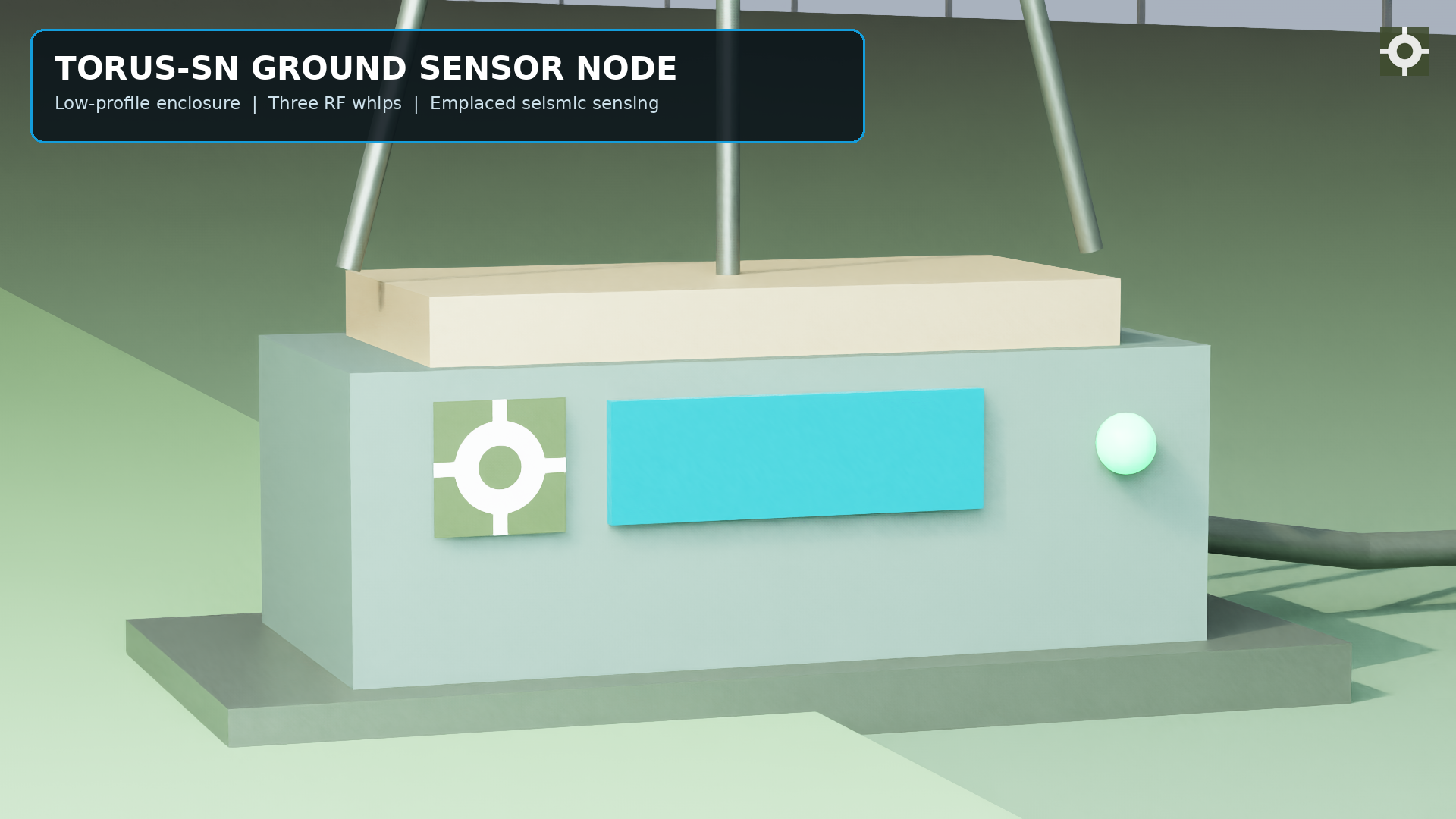
Every sensing channel on the TORUS-SN ground node is a named, datasheet-backed component selected for low standby power and facility serviceability. The parts below are the current design baseline.
| Channel | Detail | Parts |
|---|---|---|
| Seismic | 4.5 Hz vertical geophone into a 24-bit delta-sigma front end, power-gated between events, with a digipot-set threshold watched by an on-die comparator that trips with the processor asleep. Signatures include footfall, vehicles, and digging. | R.T. Clark 4.5 Hz, ADS1220, MCP4017, on-die COMP1/COMP2 |
| Acoustic | Two 24-bit I2S MEMS microphones give a stereo field for on-device classification. Acoustic Activity Detect runs always-on inside the microphone at 20 µA per part with no processor involvement. Audio is classified at the node; raw audio never leaves it. | 2 × TDK T5848 (AAD), 1.8 V LDO |
| Radio and position | LoRa 433 MHz uplink, multi-constellation GNSS, and passive Wi-Fi AP-scan positioning from one device, plus a licensed S-band branch laid out and depopulated on EU units. A relocated node reports its own new position. | Semtech LR1120, 32 MHz TCXO, PE4259 SPDT |
| Compute and autonomy | Cortex-M33 host with TrustZone, LPBAM autonomous peripherals down to Stop 2, and on-device INT8 inference. Primary lithium cell behind reverse-blocking and a supercapacitor pulse buffer, with independently gated sensing rails. | STM32U575xxQ, Saft LS 33600, buck-boost, BQ35100-class gauge |
Vector math is a design gate
A Lattice iCE40 UP5K vector math unit is carried as a measured design gate. See open gates.
05 · Zero-miss, priority-preemptive
The runtime guarantee is a reliability property, not a slogan. Every event is captured, ordered, and delivered, and the highest-priority event is never queued behind noise.
- Capture, each node stamps every event with a monotonic sequence number.
- Deliver, events are forwarded with de-duplication on identity; nothing is silently dropped.
- Detect gaps, a break in the sequence is flagged and replayed, so a miss is detected instead of discovered later.
- Preempt, critical security events preempt lower-priority processing in the queue.
- Decide, the operator receives a validated track with location and confidence.
On complexity, stated correctly
The runtime is a hard-real-time, zero-miss pipeline. The genuinely NP-hard problem in TORUS is optimal sensor placement for complete coverage, a set-cover / art-gallery problem. That is why the deployment is rehearsed in simulation first: the coverage problem is approximated off-line, then zero-miss processing is guaranteed on-line.
06 · A ring around data center assets
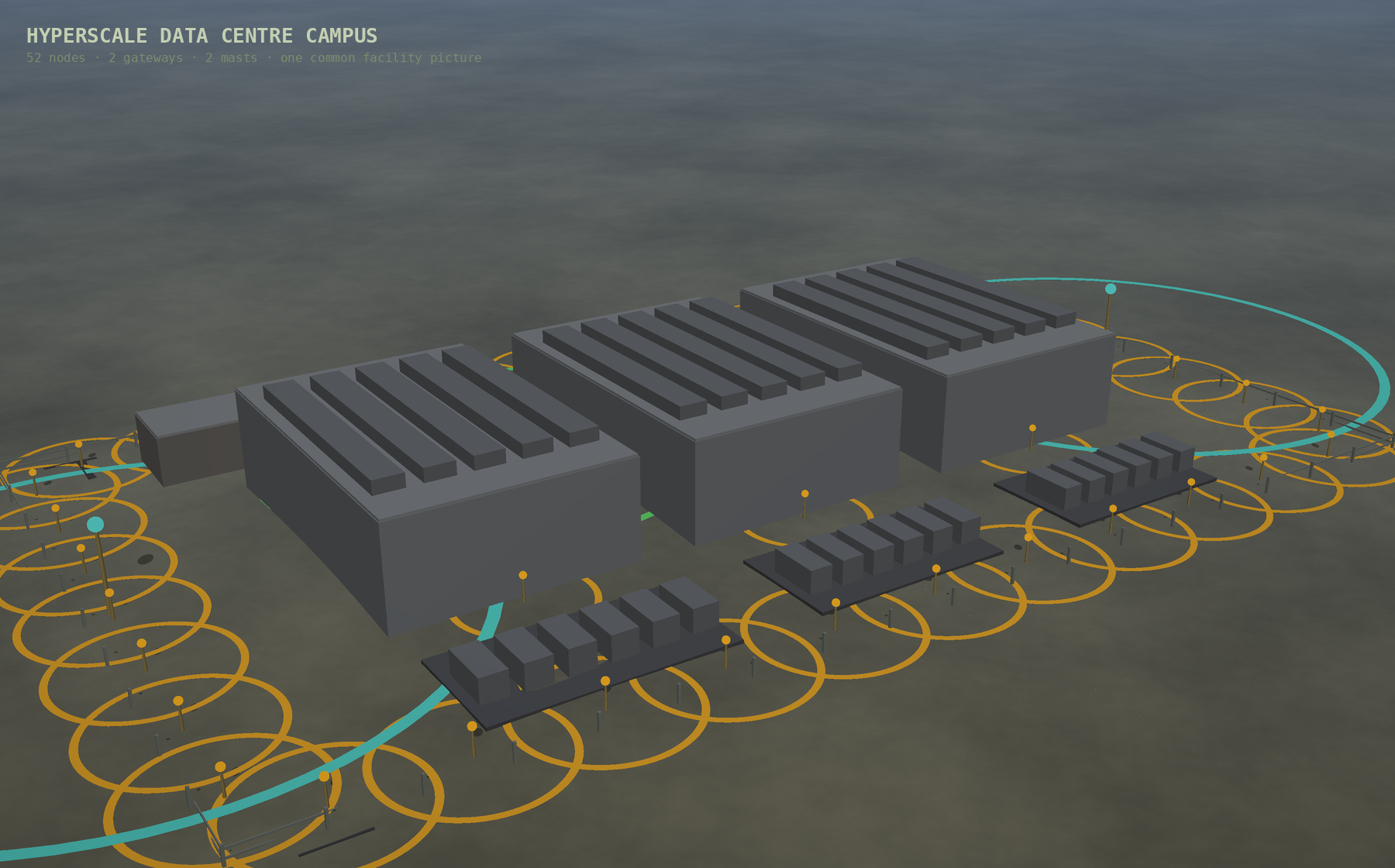
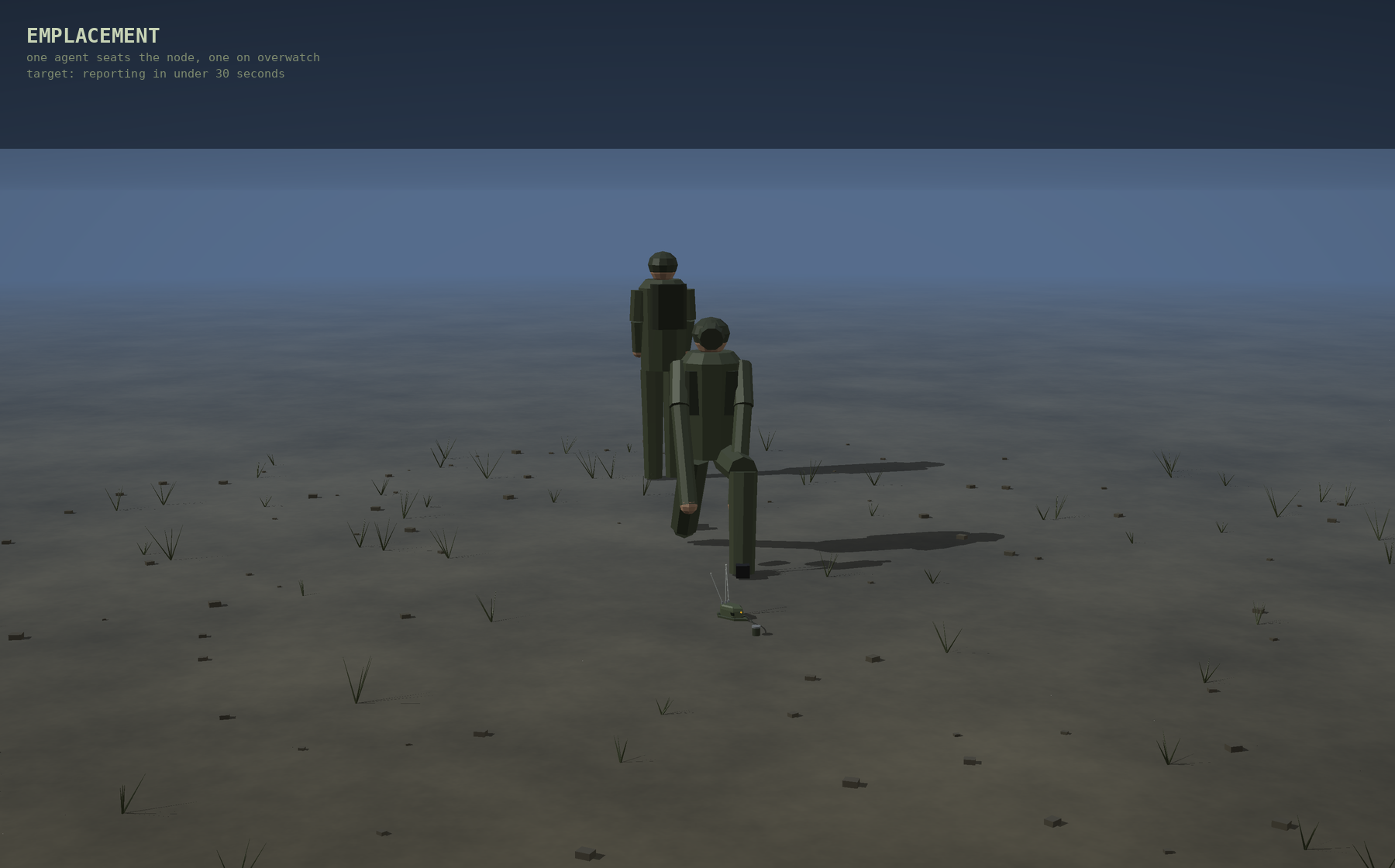
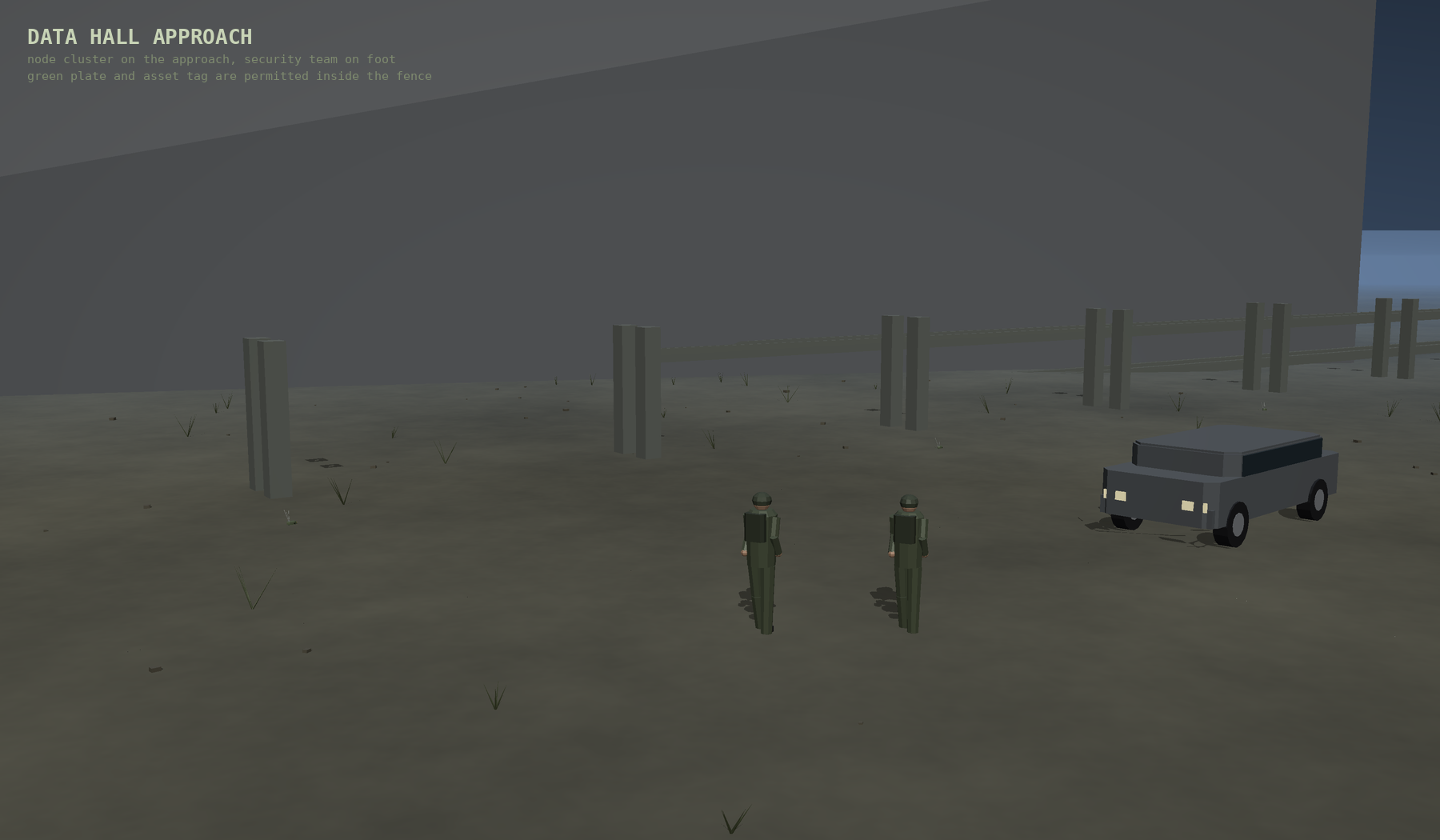
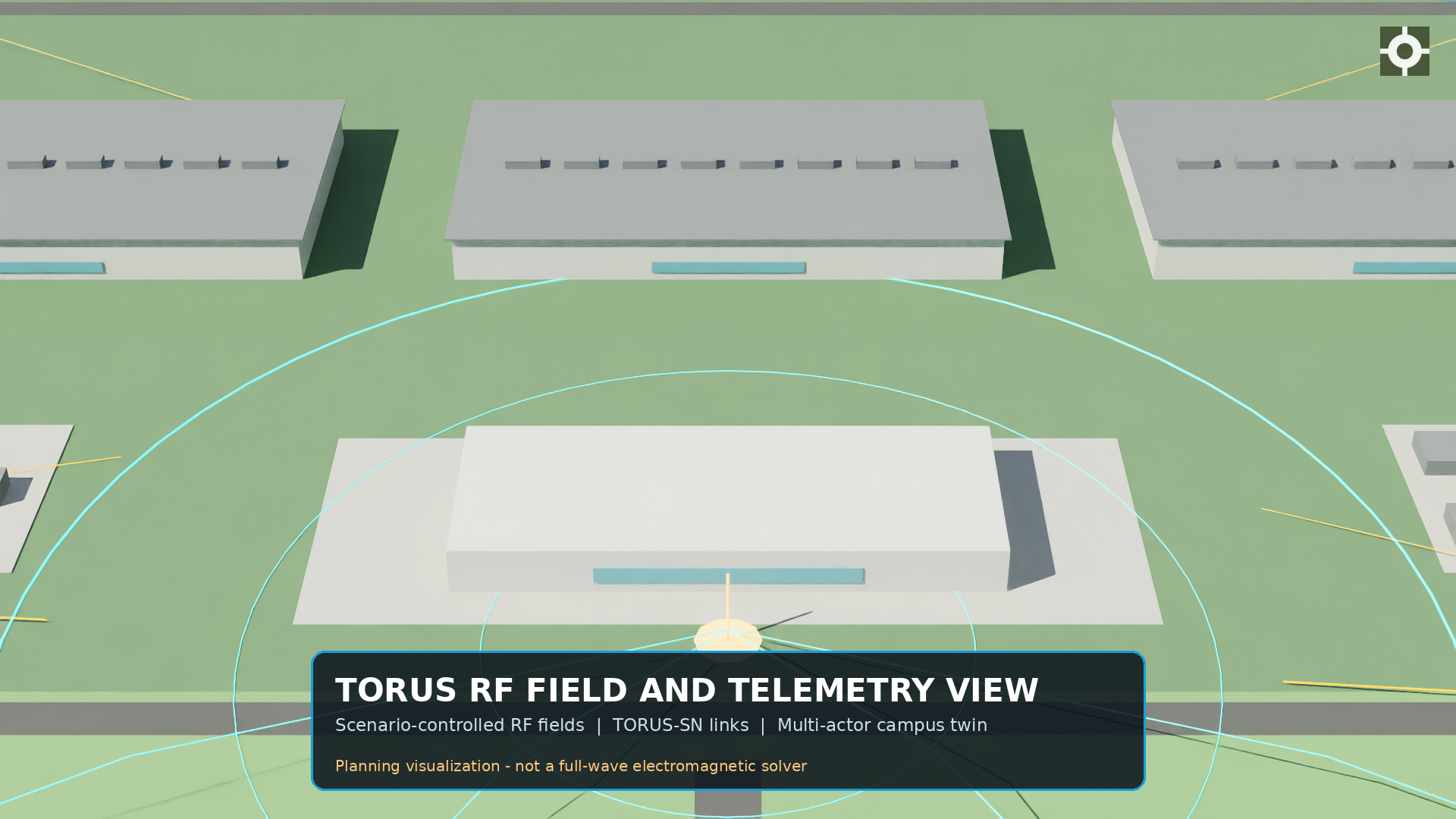
A representative data center deployment uses ground nodes on the campus perimeter, visual masts for service-yard and data-hall approaches, an experimental drone/UAS layer over the facility, and a gateway linked to facility operations.
07 · Rehearse the facility before rollout
AI/HPC campuses are expensive to survey twice. A deployment is rehearsed as a cyber-physical twin in NVIDIA Isaac Sim with terrain reconstructed from mapping data, the full system placed virtually, and unauthorized-entry scenarios run against it.
In data center campus deployments the twin helps twice. The local noise floor is simulated first, so seismic thresholds and acoustic classifiers arrive on site pre-tuned against cooling plant, generator, and traffic background instead of by trial and error.
08 · Facility sensor network, gateway, operations
| Layer | Element | Role |
|---|---|---|
| Edge | TORUS-SN nodes | Mixed node classes sense passively and classify at the edge, reporting compact events over LoRa, SDR, or optical. AI at the edge. |
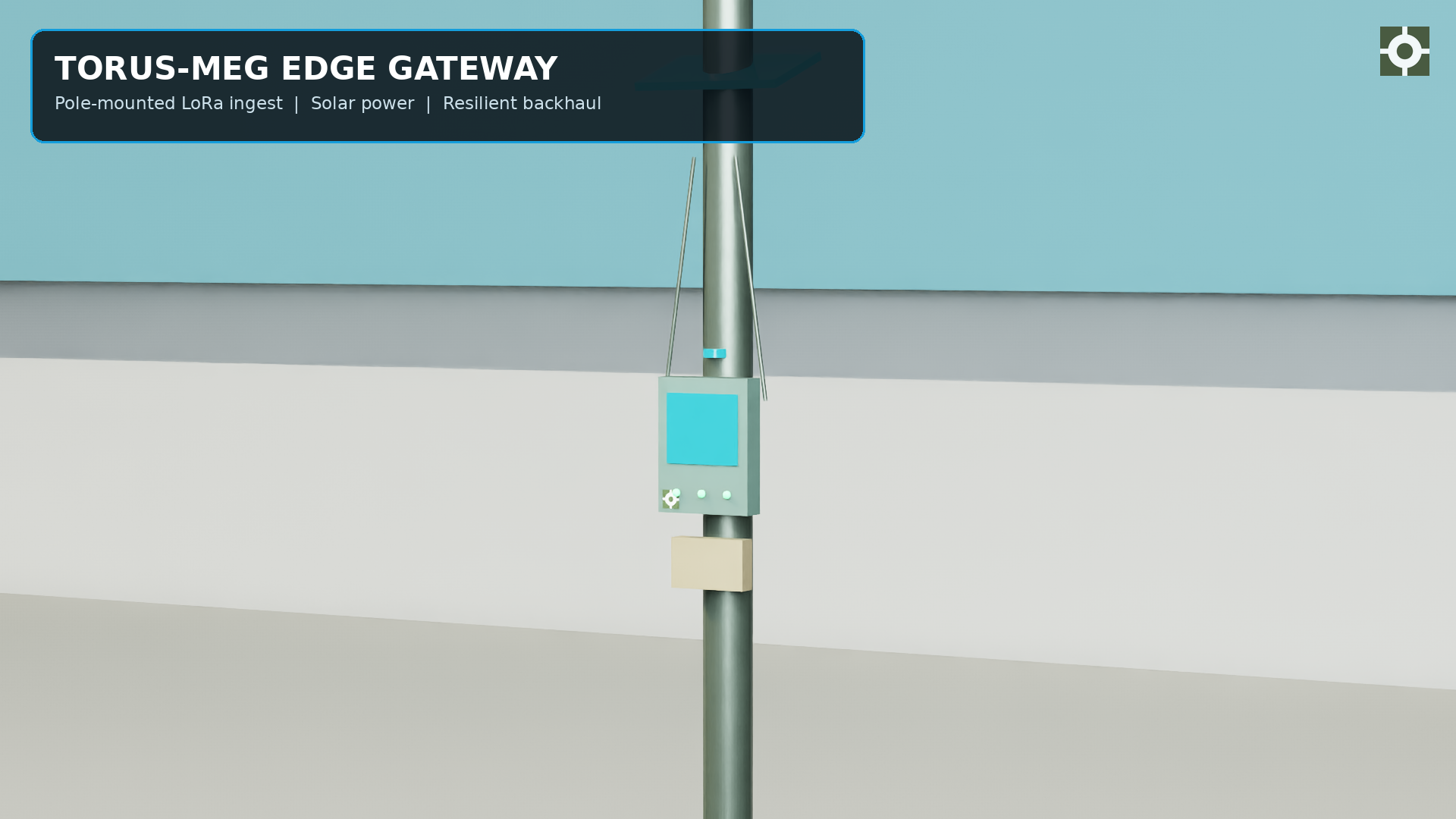
| Aggregation | TORUS-MEG gateway | Receives the facility field, fuses and timestamps events on a Jetson-class edge computer, and forwards over flexible backhaul. Cluster-aware gateways chain and federate across distances for high availability. |
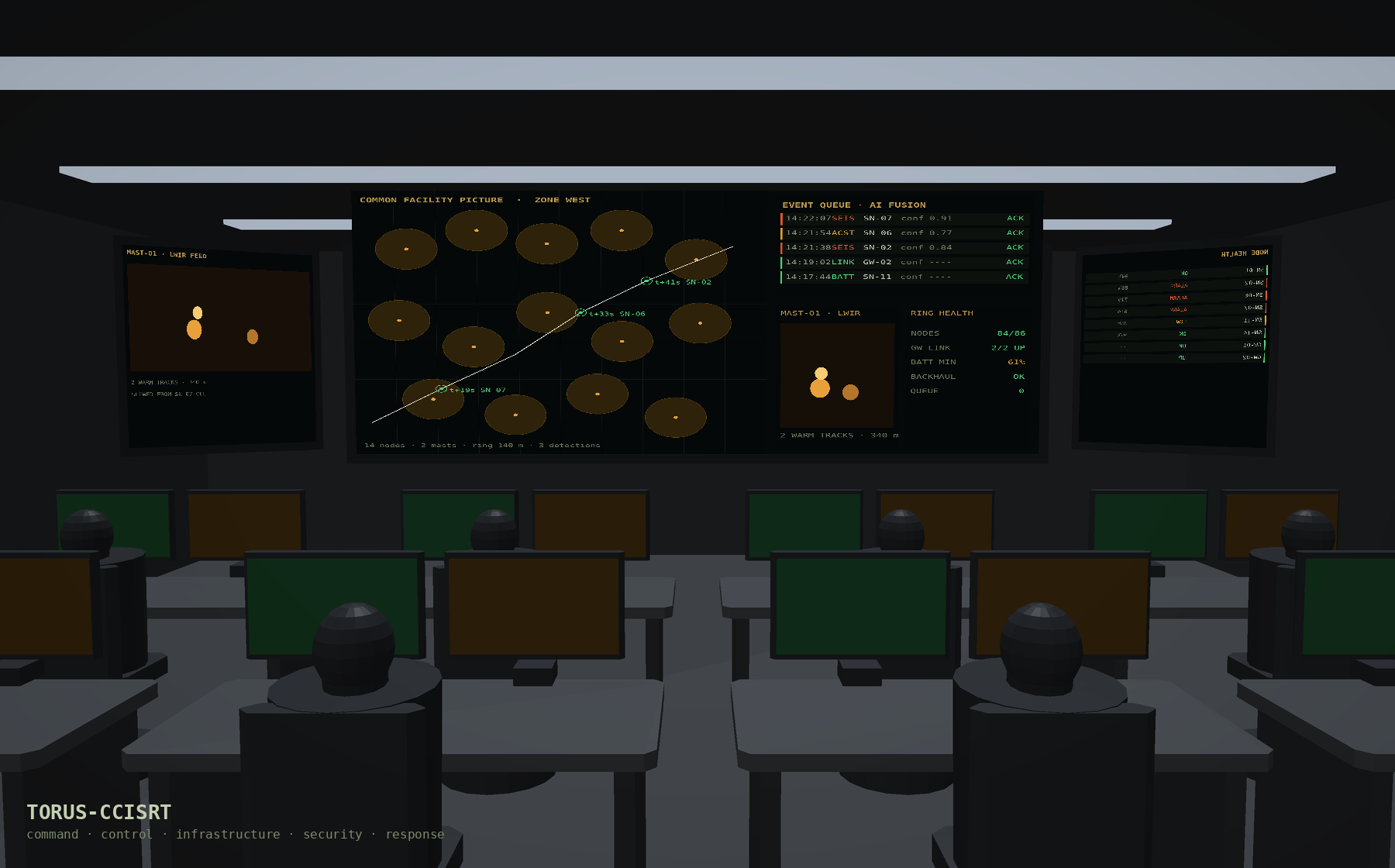
| Facility operations | TORUS-CCISRT | The operator layer provides one live common operating picture for the room and facility teams, with facility response actuation under transducer safety interlock. AI at facility operations. |
09 · One picture, two vantage points
Command, Control, Infrastructure, Security, Response, and Tier. The operations room and facility team share a single fused picture; each sees it in the form the job needs, and response nodes actuate only through the interlock.
Common operating picture. Map wall with live node, gateway, and mast state; fused prioritised alerts; triage and escalation; thermal and video cued from the masts; timeline replay; deployment planning with the Isaac rehearsal link; northbound REST API and webhooks for PSIM, DCIM, BMS, VMS, SIEM, Redfish, BACnet, ONVIF, and MQTT adapters.
torus-ccisrt · runnable reference application
Rugged tasking app. Handheld map with own position and the node ring; prioritised alerts with bearing and distance; cue a sensor or mast; confirm or reclassify on site; offline-tolerant sync over the gateway.
Offline tolerant · degrades gracefully
10 · Built to be trusted with the response
| Property | Detail |
|---|---|
| Interlock | No trigger without validation. A transducer walks arm, safety-validate, then trigger. The trigger is refused until validation passes. |
| Audit | Every command logged. Who armed, validated, or triggered what, and when, is recorded for post-incident review. |
| Deployment | On-prem or private cloud. The CCISRT layer runs on-premises or private cloud, with an offline option for controlled data center environments aligned to TIA-942 and OCP operational expectations. |
11 · Read the detail
| Reference | Document | Covers |
|---|---|---|
TORUS-SN-DS-001 |
TORUS-SN node | Ground sensing node, in detail. |
TORUS-SNV-DS-001 |
Node variants | The four node classes and their trade-offs. |
TORUS-MEG-DS-001 |
TORUS-MEG gateway | Aggregation, fusion, backhaul, clustering. |
TORUS-CCISRT-DS-001 |
TORUS-CCISRT | The command layer and operator applications. |
TORUS-AI-001 |
AI/ML Engine | Intelligence at the edge, gateway, and facility operations. |
TORUS-PROG-001 |
Programme status | What is built, and the roadmap. |
Interactive
Power calculator Isaac Sim rehearsal Imagery and 3D library