TORUS
TORUS Unattended Air-Ground-Visual Sensing

Passive Perimeter Sensing for AI/HPC Data Centers

TORUS is a UAGVIS platform, Unattended Air-Ground-Visual Sensing. It extends the unattended ground sensor model that perimeter security has relied on for decades into the two domains a data center campus also has to cover, eye level and the air above it. Seismic and acoustic sensing in the ground, thermal and LiDAR confirmation at eye level, and drone or UAS detection overhead, classified at the edge with on-device AI and driving facility response under safety interlock.
Documentation Simulation Datasheets TORUS-CCISRT GitHub Repo ↗
The perimeter

What Cameras Alone Cannot See

Campus perimeters, service yards, data hall approaches, substations and cooling plant areas need continuous awareness, and they are exactly the zones where power, network and staffing are thinnest. Fence sensors nuisance-trip on weather. Cameras need light, bandwidth and someone watching. TORUS emplaces low-signature nodes that listen to the ground and the air, decide locally what an event is, and only then raise it.

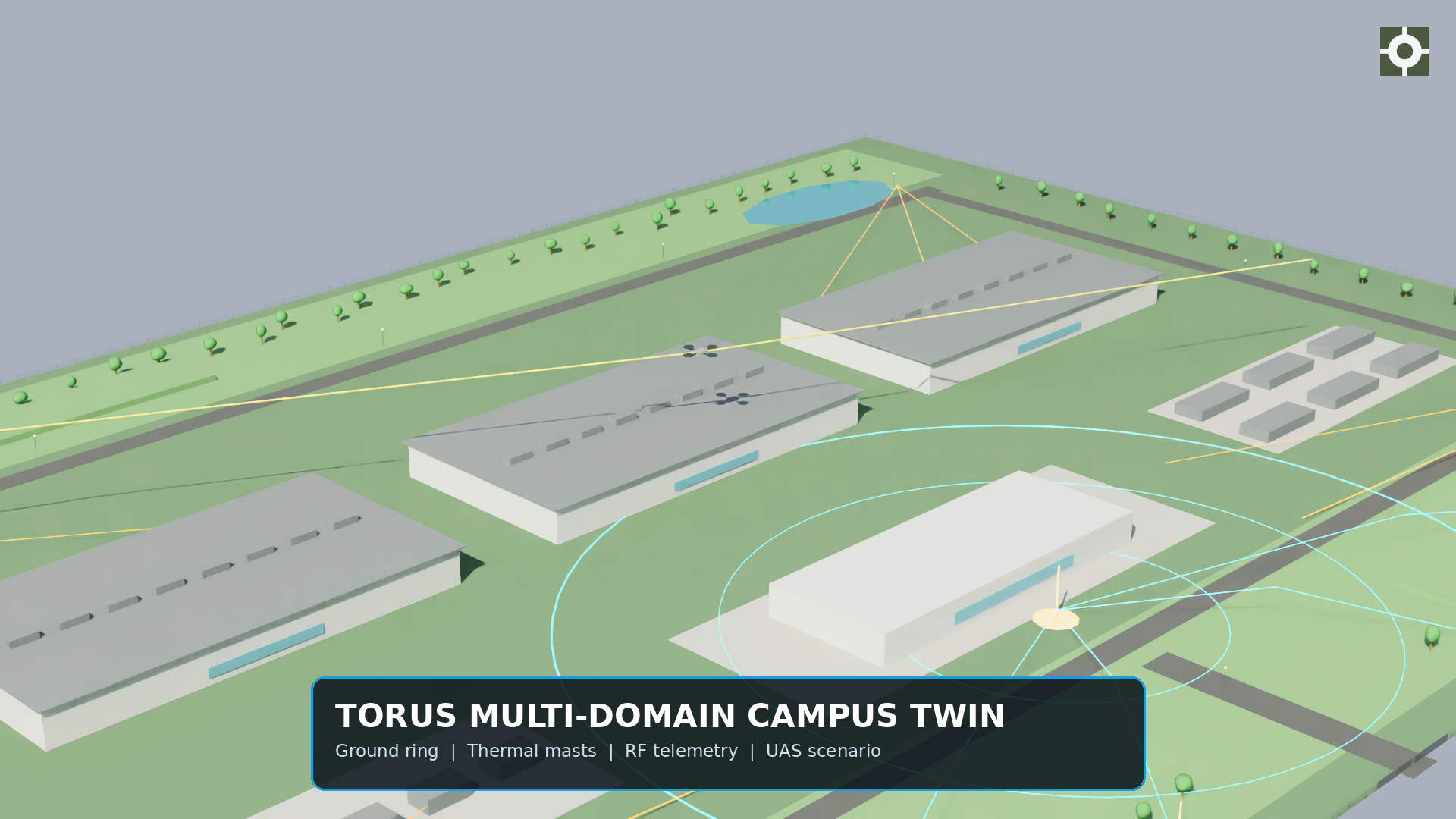
Campus rehearsal combining the TORUS ground ring, visual masts, RF telemetry and a low-altitude drone track
Multi-domain campus rehearsal combining the ground ring, SN-TIR masts, RF telemetry and a low-altitude UAS track.
The platform

Four Node Classes, One Event Contract

Every node speaks the same event contract, so a site can mix wireless, software-defined radio, wired optical and transducer classes without changing the command layer.

TORUS-SN low-profile emplaced sensor node

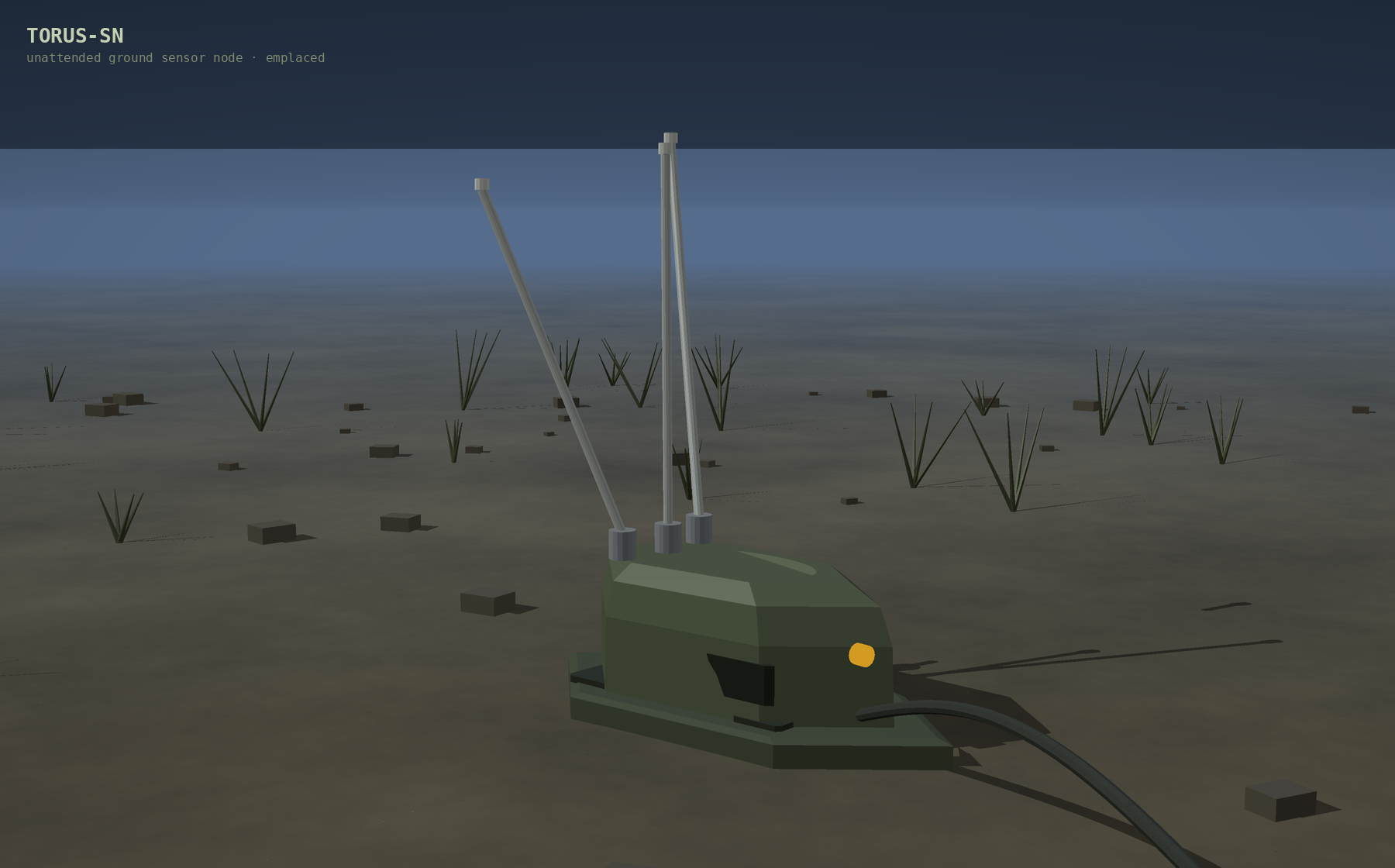
TORUS-SN

The ground sensing element. A 4.5 Hz vertical geophone and a stereo microphone pair on an STM32U575 host, with zero-processor acoustic activity detect, INT8 classification on-device, and multi-year endurance from a single primary cell.

Datasheet · Power model

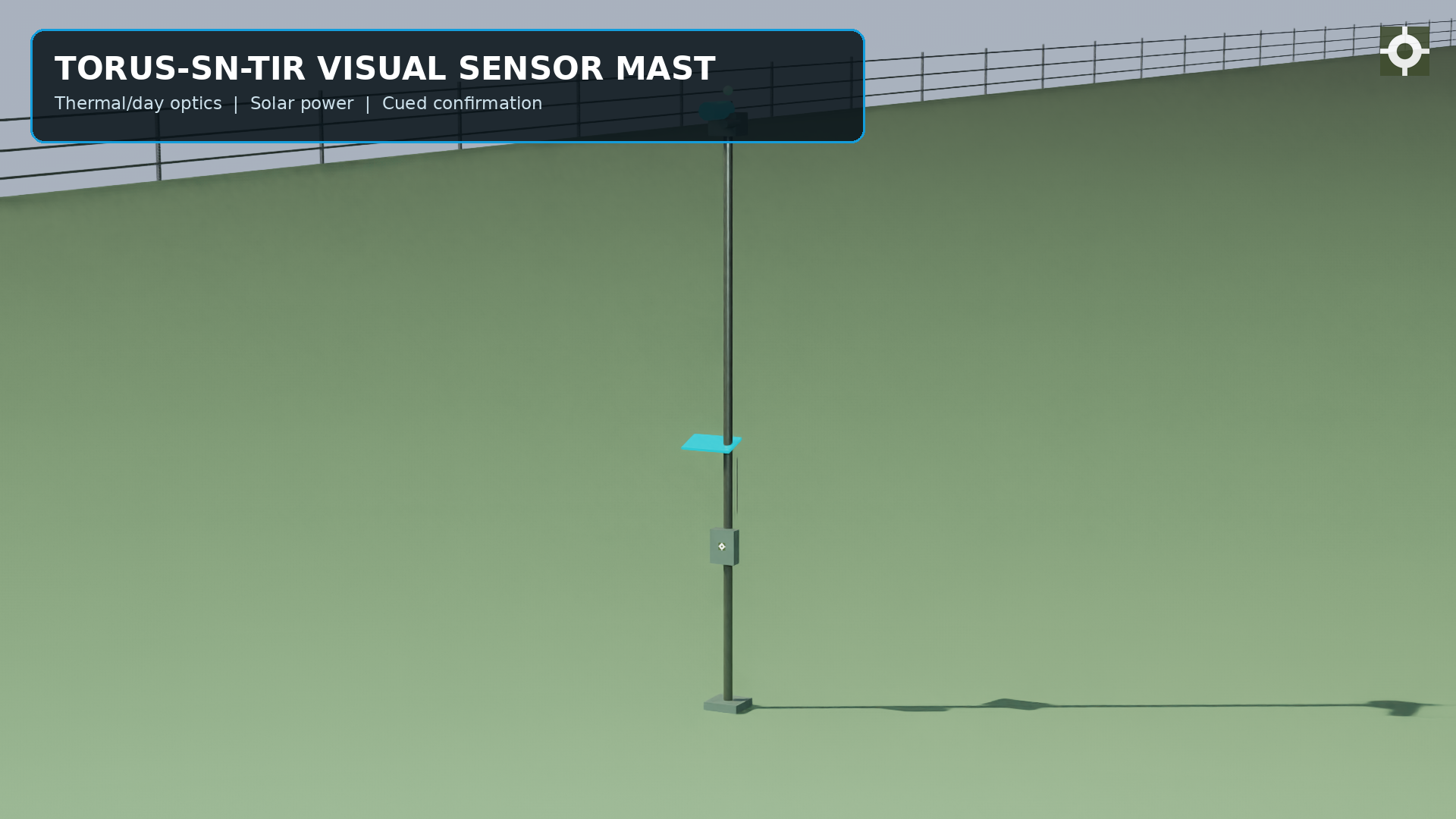
TORUS SN-TIR thermal and day optics mast

SN-TIR visual mast

Six metres of mast carrying thermal and day optics with solar power and its own radio. The ground ring cues it, so the optics confirm a track that has already been detected rather than sweeping empty ground.

Node variants

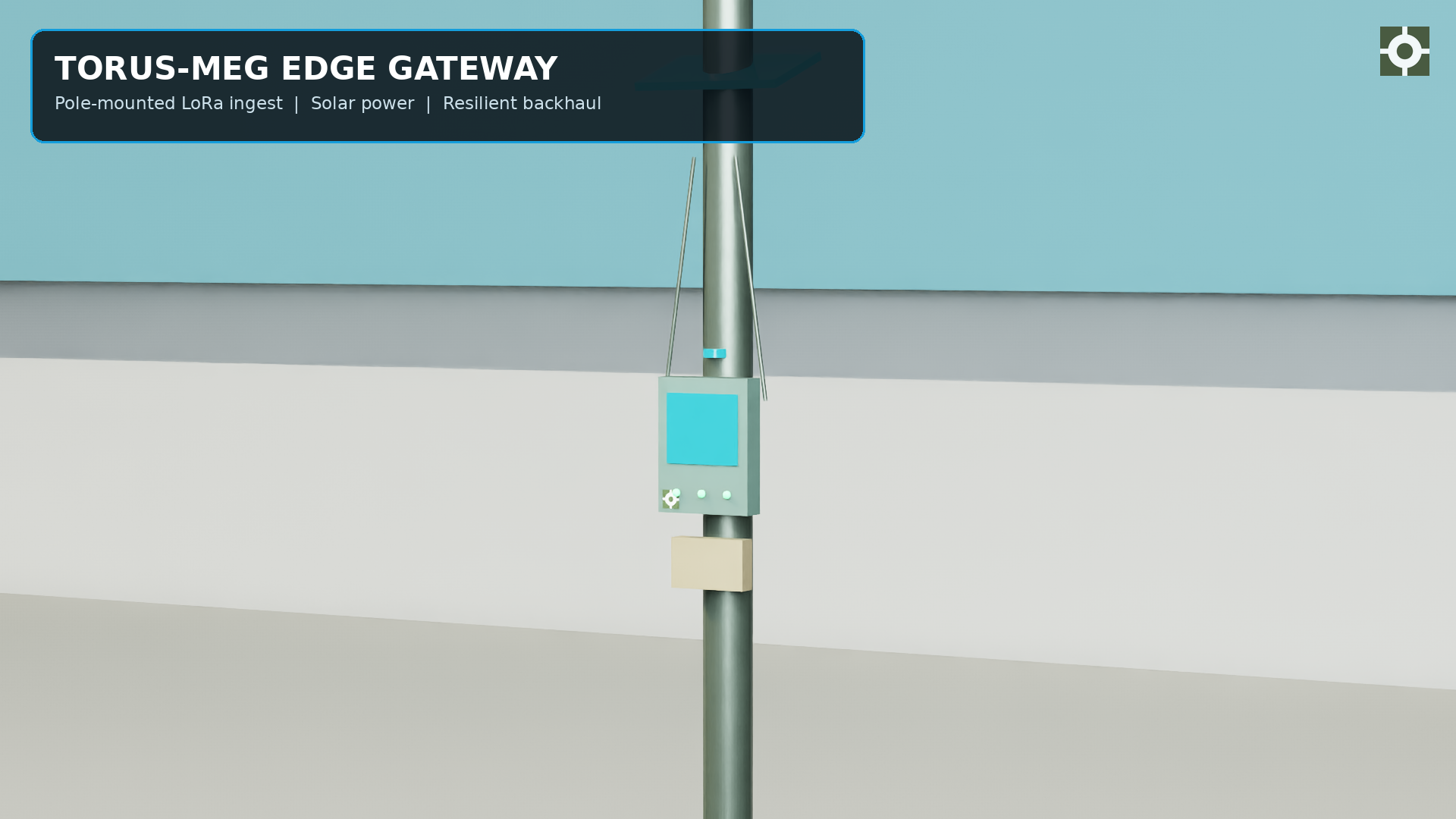
Pole-mounted TORUS-MEG gateway with solar panel

TORUS-MEG

The cluster-aware field gateway. An 8-channel LoRa concentrator, NVIDIA Jetson Orin-class edge compute for sensor fusion, GNSS-disciplined time, and flexible backhaul over Ethernet, Wi-Fi, cellular or satellite.

Datasheet

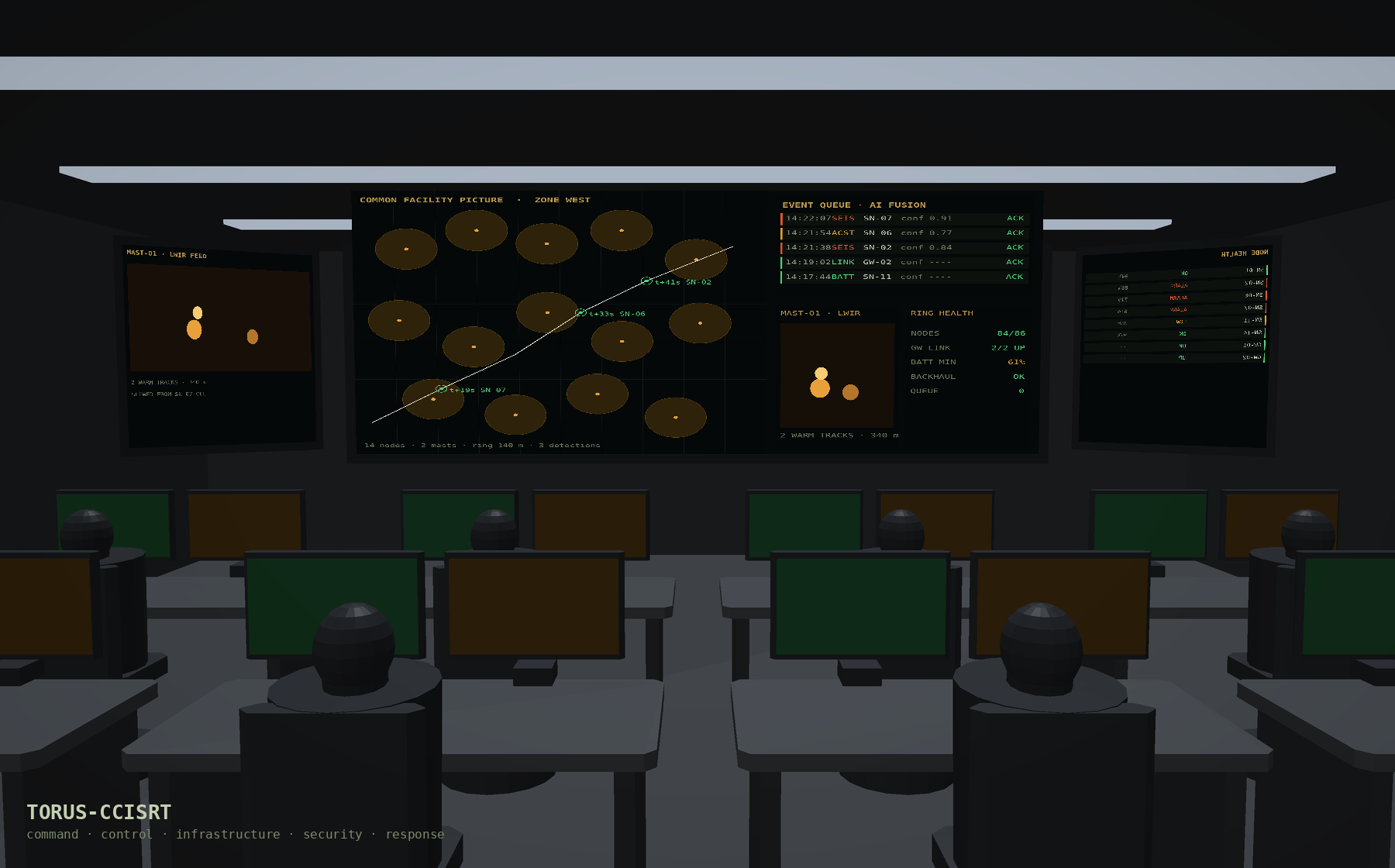
TORUS-CCISRT command layer in an operations room

TORUS-CCISRT

The command layer. One live common operating picture that correlates node evidence into a classified track with location and confidence, and holds response actuation behind a safety interlock.

Command layer microsite · Datasheet

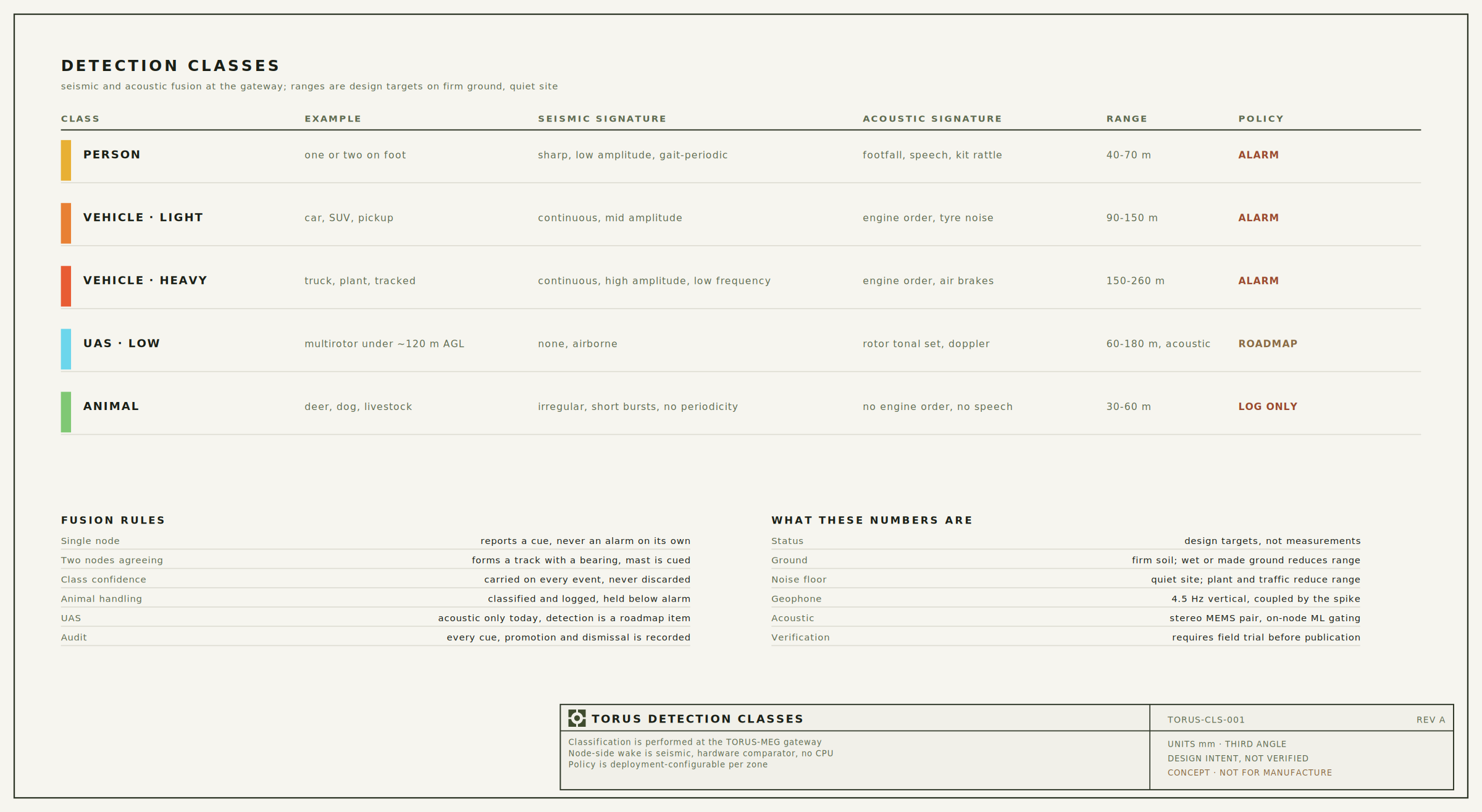
TORUS detection classes: human, vehicle, drone and animal

AI/ML engine

Intelligence at three tiers. TinyML on the node decides what is worth sending, the Jetson at the gateway fuses across nodes, and the command layer correlates tracks across the whole campus.

AI/ML engine

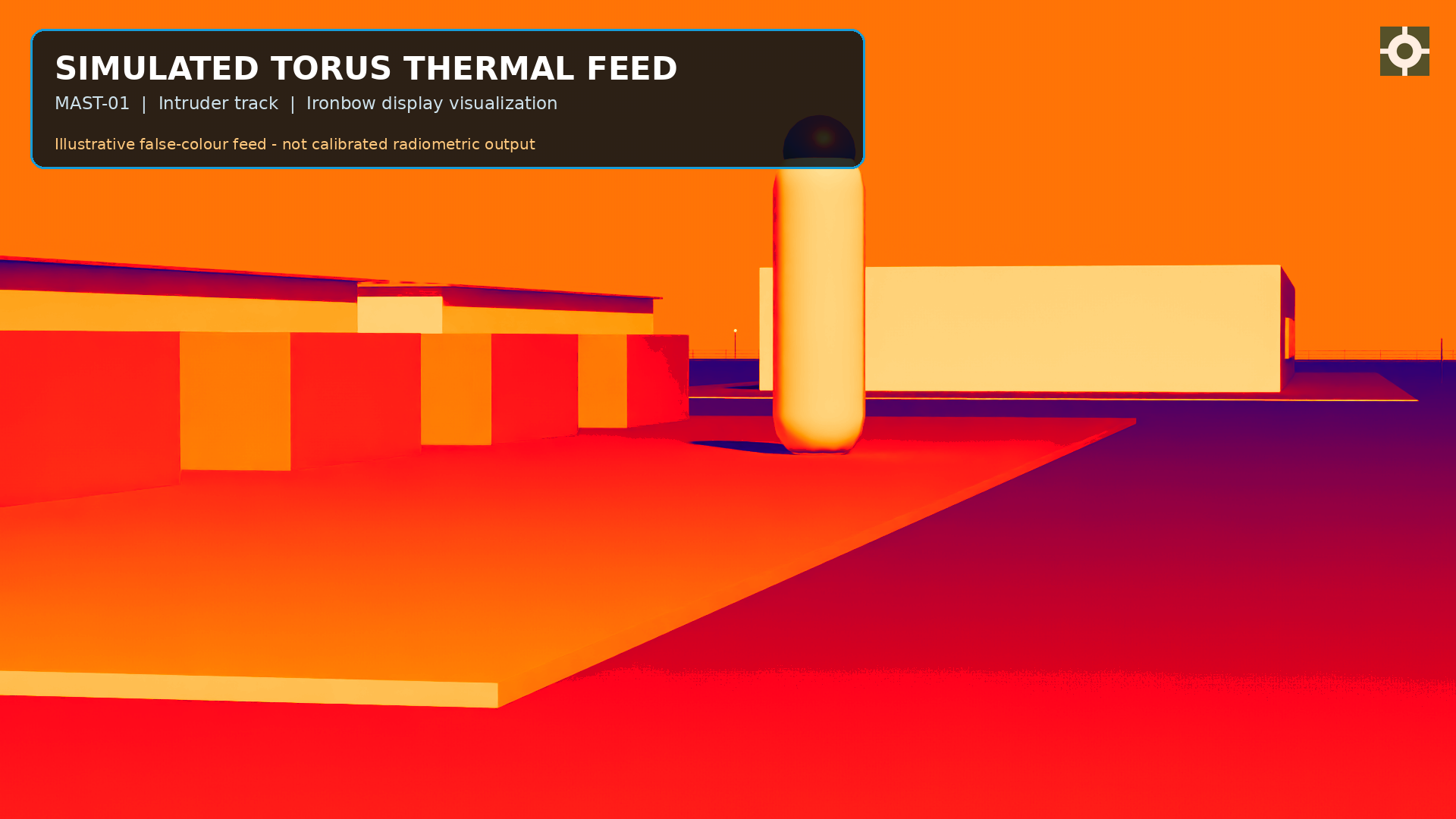
Illustrative ironbow thermal display from a TORUS mast

Zero-miss pipeline

Every event is stamped with a monotonic sequence number, forwarded with de-duplication on identity, and any break in the sequence is flagged and replayed. Critical events preempt lower-priority processing end to end.

Capability overview

Deployment rehearsal

Rehearse the Facility Before Anything Is Emplaced

The campus is written as an OpenUSD stage and rehearsed in NVIDIA Isaac Sim. Node positions, ring geometry, per-node gain and threshold settings, detection and false-alarm rates per class, and labelled training data all come out of the twin before hardware is committed. Scenarios exercise the four object classes across all three UAGVIS domains in one scene, so air, ground and visual coverage are planned against one another.

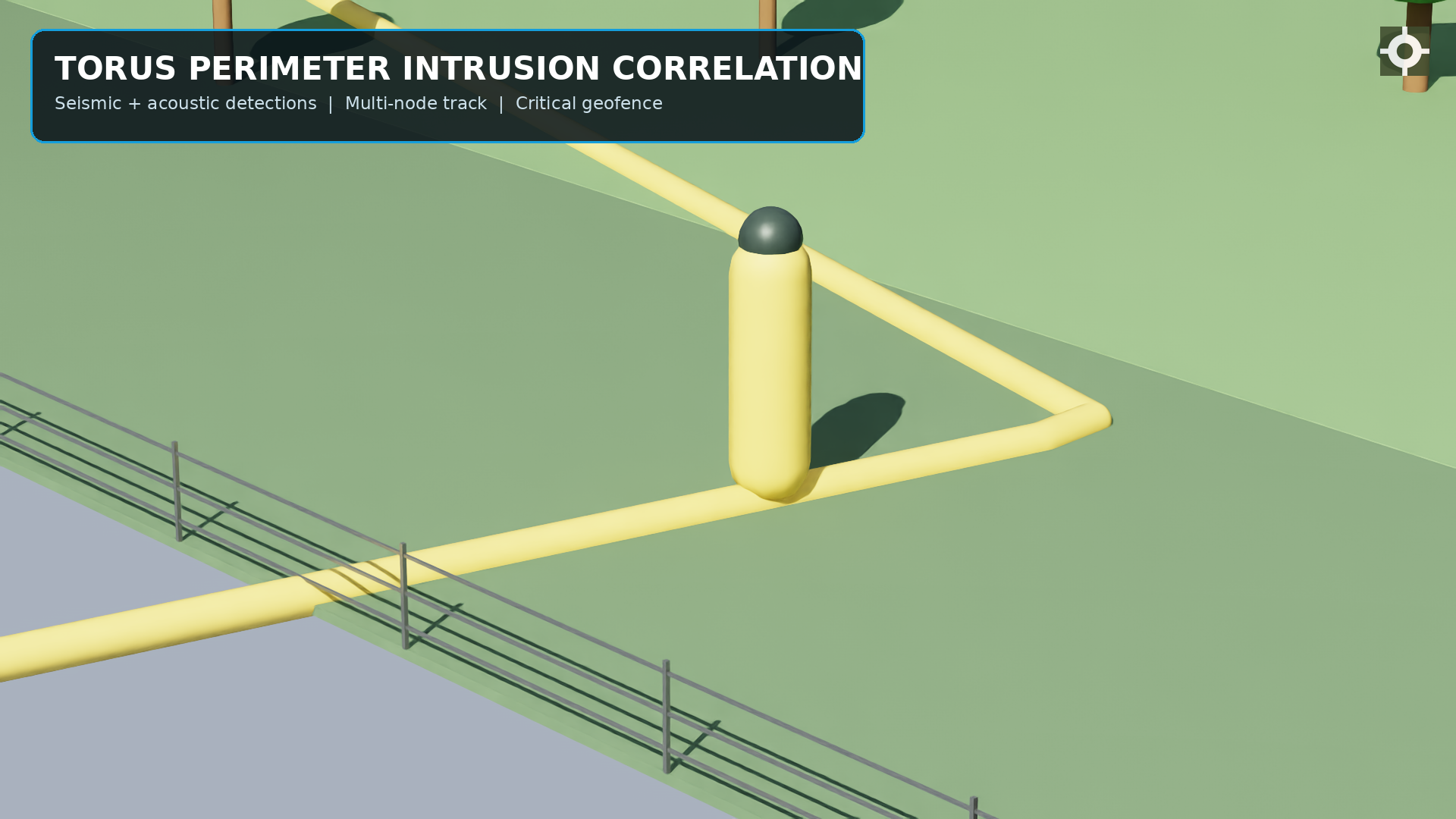
Perimeter intruder route with correlated TORUS detections
Intrusion correlation with the active route and multi-node detection evidence around a protected geofence.
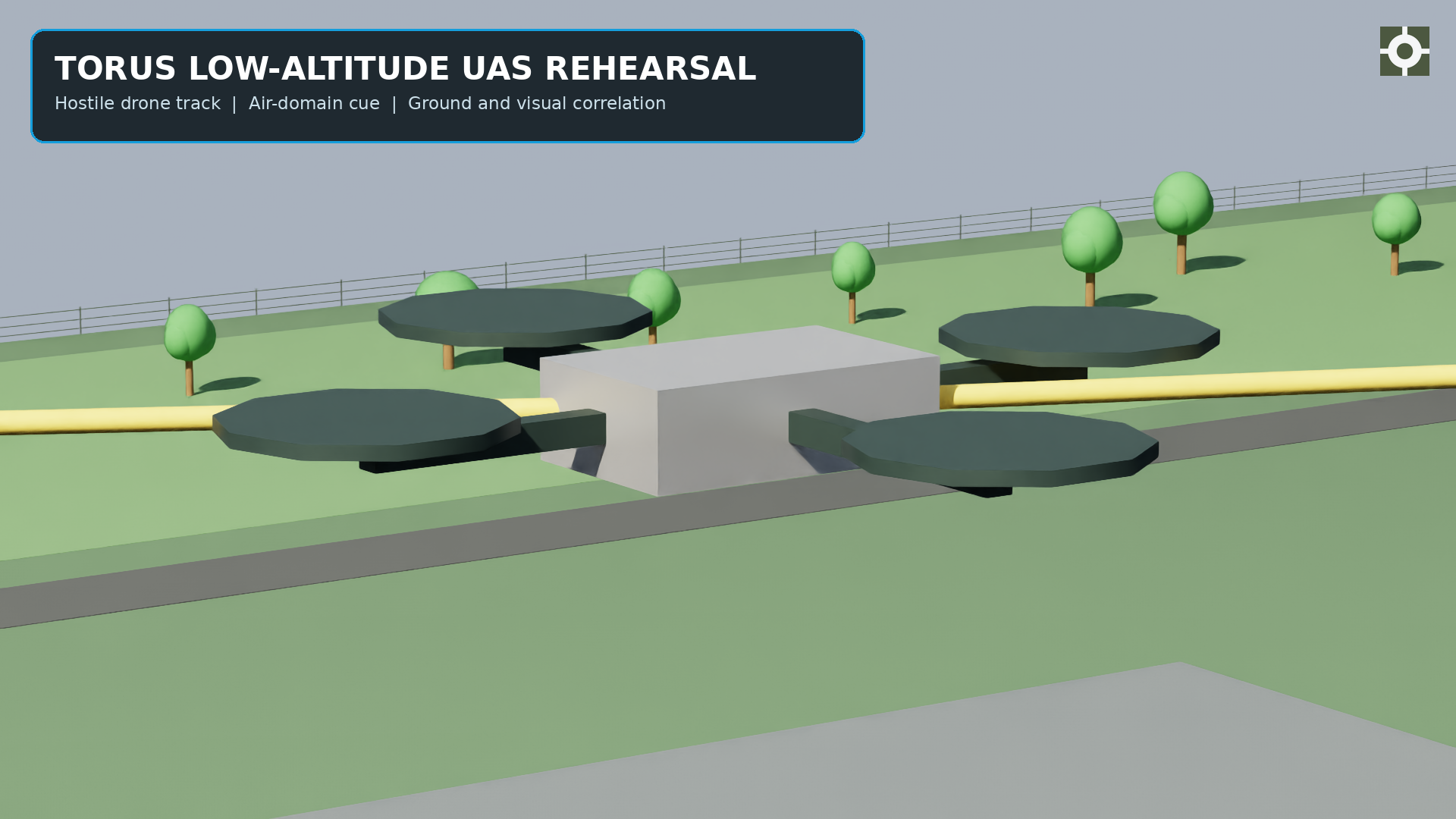
Low-altitude drone crossing the TORUS campus in Isaac Sim
Low-altitude UAS rehearsal for correlating air-domain cues with ground and visual sensing.
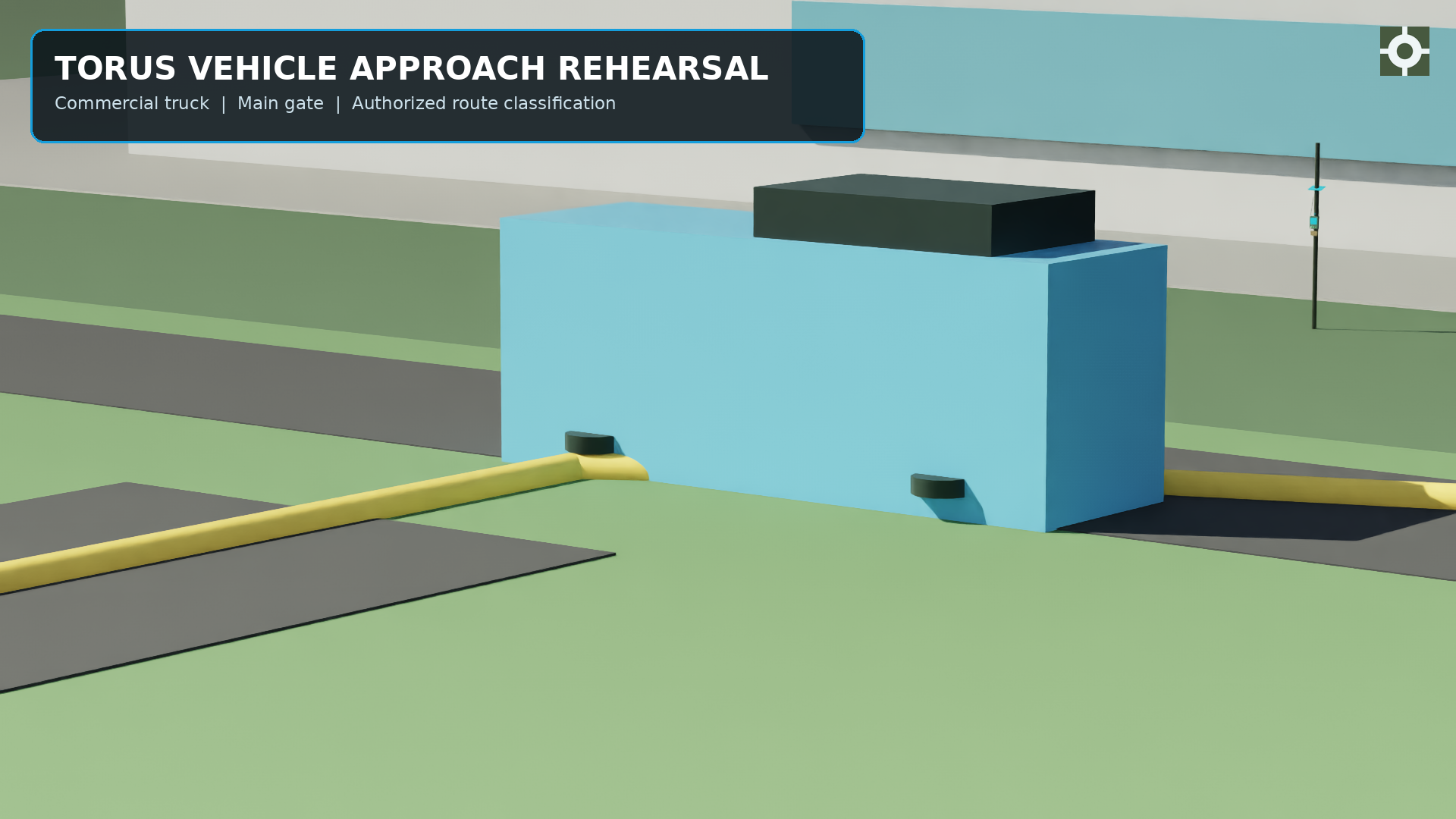
Delivery vehicle approaching the data center gate in Isaac Sim
Authorized commercial-vehicle approach with route context for gate classification and policy testing.

The simulator ships with its own guides: how to install, configure, run, capture and troubleshoot it, the full parameter reference for scenario authoring, and the build, deploy and use path for getting results back into the commissioned plan.

TORUS Isaac Sim User & Developer Guide Parameter Reference Build, Deploy & Use Imagery & 3D Library
Documentation

Datasheets and Programme Status

The documentation site is the current record for every part of the platform. It tracks the design baseline directly, so the component tables, power figures and open engineering gates on these pages are the ones the hardware is being built to.

For evaluation. Specifications are preliminary and subject to change without notice. Endurance and capacitor figures are planning-model outputs and are not released as guaranteed specifications until bench measurement closes the open gates recorded on the status page.

Built on Open Technologies

Node firmware is built on Zephyr RTOS, so the same application runs across the node classes and their differing radios. The campus around those nodes is written as an OpenUSD stage, which opens in NVIDIA Isaac Sim, usdview, Blender or any other USD-capable tool, and edge inference at the gateway runs on NVIDIA Jetson.

Zephyr, OpenUSD, NVIDIA, Isaac Sim and Jetson, and their logos, are trademarks of their respective owners. They are shown to indicate the technologies TORUS builds on and interoperates with. TORUS is not affiliated with, sponsored by or endorsed by these projects or companies. The Zephyr logo is from the Zephyr Project documentation assets, used under Apache-2.0; Zephyr is a registered trademark of the Linux Foundation. The NVIDIA logo is reproduced unaltered from NVIDIA's logo and brand usage page. OpenUSD was created by Pixar and is governed by the Alliance for OpenUSD, of which NVIDIA is a founding member.

About TORUS

TORUS is a product of PacketFive, the trading name of Packet Five Networks Limited, a research and development company based in Dublin, Ireland. We build open infrastructure for the AI/HPC data center, spanning simulation, training and facility security.

Contact PacketFive About the Company

Packet Five Networks Limited, 51 Bracken Road, Sandyford, Dublin D18 CV48, Ireland. CRO 764119.