TORUS-SN node variants
All TORUS-SN nodes share the same seismic and acoustic sensing core, the same event contract with per-source sequence numbers for zero-miss processing, and the same command integration. They differ in the communications and effect layer, which is selected per node to match cost, alarm profile, assurance requirements, and facility constraints.
A single deployment routinely mixes classes: cheap fixed-wireless nodes cover the bulk of a ring, programmable or wired nodes sit on the highest-value segments, and transducer nodes are placed only where a response is authorised.
01 · Variant comparison
| # | Variant | Link / RF | Relative cost | Maturity | Best fit |
|---|---|---|---|---|---|
| 1 | Fixed Wireless | LoRa 433 MHz | Low | Fielded | Wide, dense perimeter rings |
| 2 | Programmable Wireless | SDR AD9371 / AD9363 + LoRa failsafe | High | R&D | Experimental, R&D, high-assurance facility segments |
| 3 | Wired Optical | Optical fibre | Site dependent | R&D | Highest-assurance, emanation-quiet segments |
| 4 | Transducer | per host node | Add-on | Concept | Authorised, validated response points |
Hardware design status
Only variant 1 has a complete hardware design: generated schematic, 4-layer
PCB, and 3D model at pre-production. Variants 2, 3, and 4 are at
design-brief stage, with host architecture, block diagram, candidate BOM, and
open engineering flags documented per variant in the repository under
hw/variants/, and no schematic or PCB yet.
The SDR variant requires an FPGA or SoC-class host, because the AD9371 JESD204B interface cannot be serviced by the V1 node's MCU. It is therefore architected as a carrier board stacked on an unmodified V1 node.
02 · Variant 1 · Fixed Wireless (LoRa)
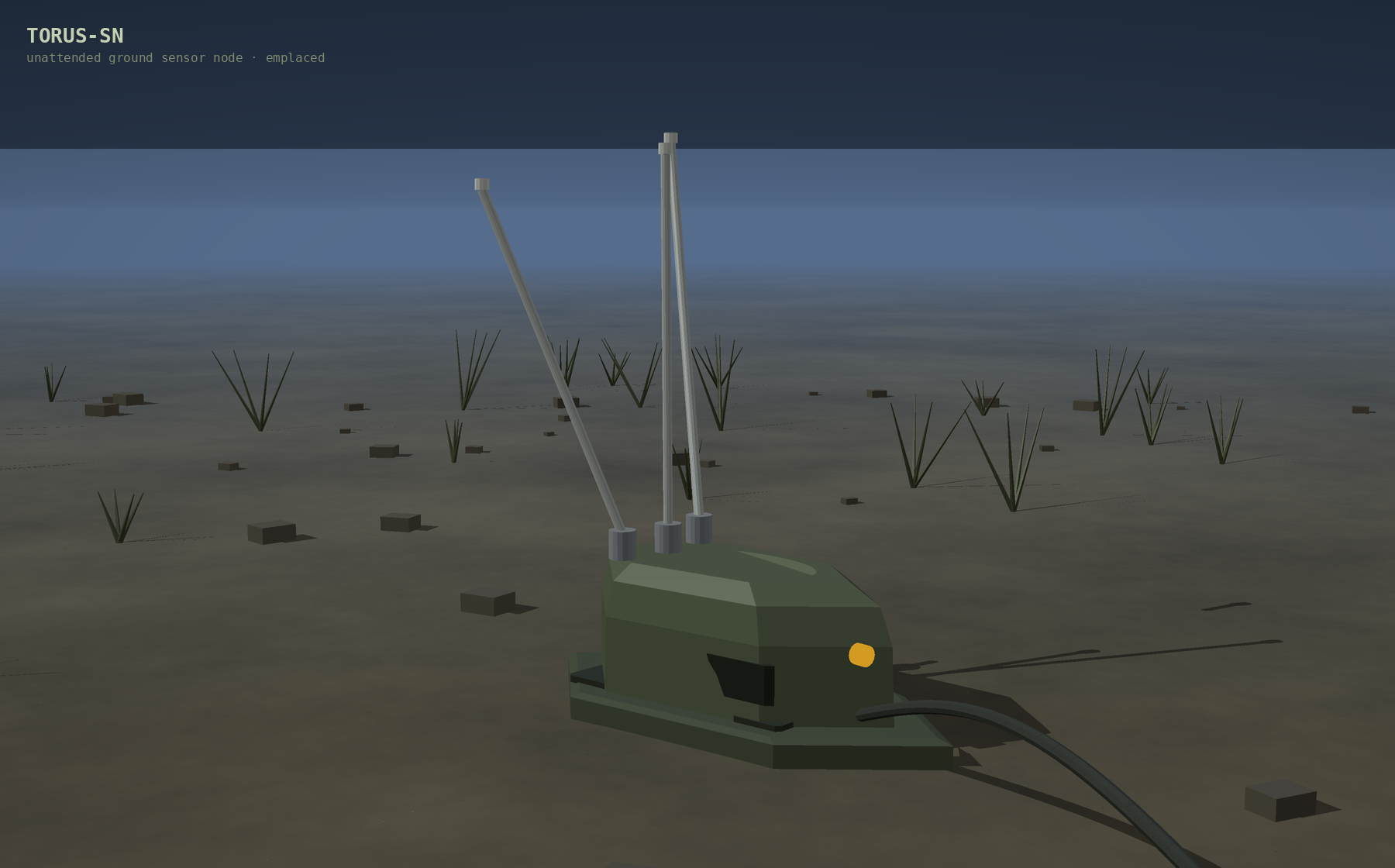
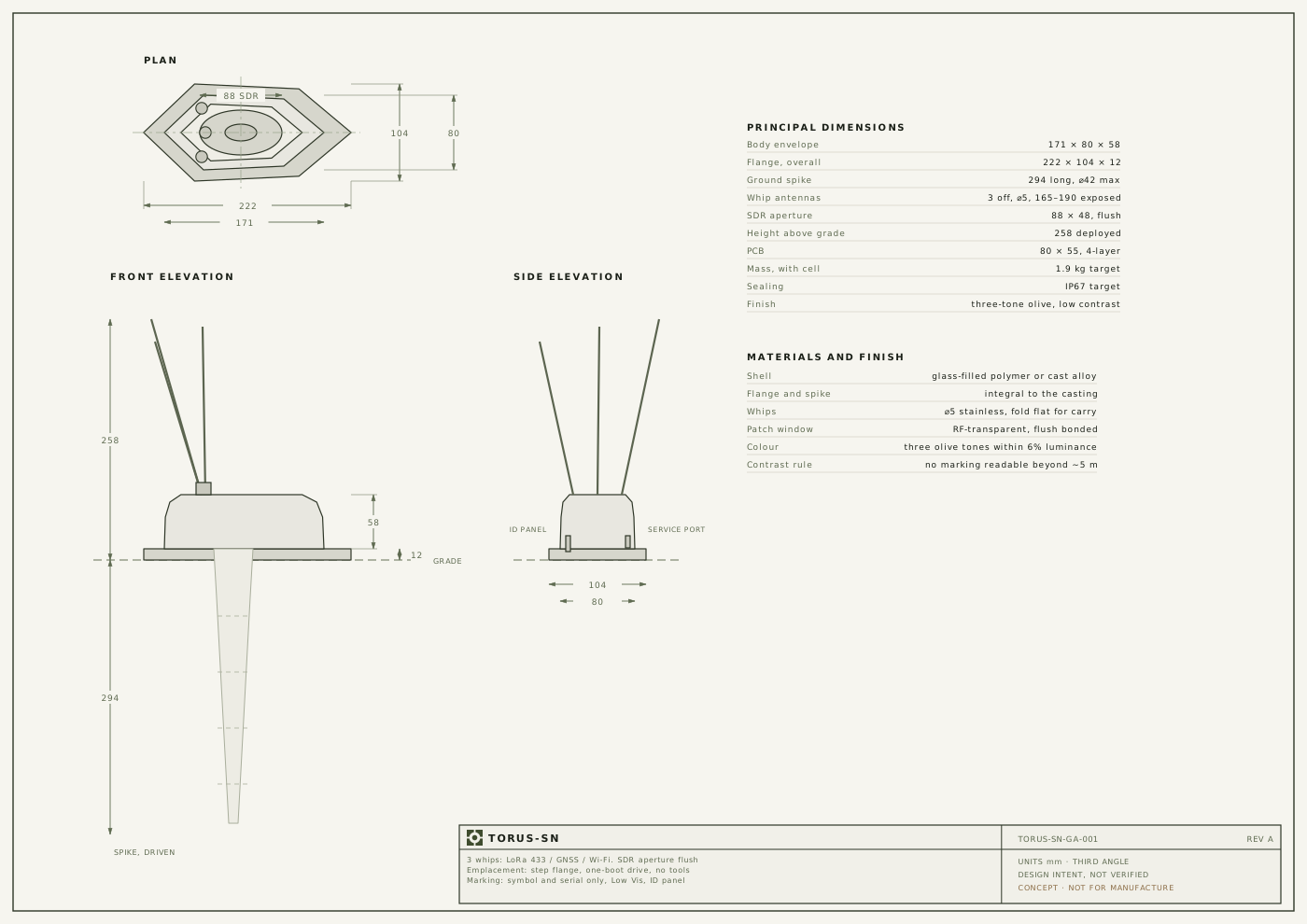
The fixed-wireless node is the lowest-cost default element for the bulk of a perimeter ring. It uses a fixed-function LoRa 433 MHz EU ISM long-range uplink to the TORUS-MEG gateway via SMA antenna, with no field reconfiguration of the RF. That keeps power and cost down.
This is the TORUS-SN board described by TORUS-SN-DS-001, on the
STM32U575xxQ and LR1120 baseline.
Mechanical exchange
03 · Variant 2 · Programmable Wireless (SDR)
Programmable wireless uses a software-defined radio front end with Analog Devices AD9371 preferred and AD9363 as a lower-cost option, for reconfigurable waveform, band, and protocol.
| Property | Detail |
|---|---|
| Failsafe | Ships with a LoRa failsafe. The LoRa link is a guaranteed fallback and can also serve as the main link. |
| Trade-off | Significant per-node cost premium, justified for experimental and R&D deployments, spectrum work, and high-assurance facility or congested-RF requirements. |
| Economy rule | Where LoRa alone meets the requirement, variant 1 is the more economical choice and the SDR is not warranted. |
| Power and compute | Higher power draw and compute demand than the fixed variant; power budget and enclosure sized accordingly. |
Engineering flag
The AD9371 / AD9363 carrier board, clocking, and power tree are a distinct
design from the fixed node and are not on the pre-production TORUS-SN PCB. A
Zynq-class host is required for the JESD204B interface. See
hw/variants/sn-v2-sdr.md for the design brief.
04 · Variant 3 · Wired Optical
Wired optical uses optical fibre instead of RF, so there is no radio emanation to detect or jam. It is tamper-resistant and emanation-quiet, suited to the highest-assurance segments of a perimeter where wiring is feasible.
| Property | Detail |
|---|---|
| Assurance | Trades the free-placement advantage of wireless for assurance. Used selectively, not across a whole ring. |
| Transport | Optical fibre. |
| Status | Under research. Optical transceiver, powering, and mechanical integration are in development. |
| Design brief | Covers a host swap for an RMII EMAC plus a 100BASE-FX PHY, with an ADIN1110 10BASE-T1L fallback. |
05 · Variant 4 · Transducer (activate / trigger)
The transducer is a response node, not a sensor. On a validated cue it actuates a facility response. The response type is deployment-defined and authorised separately.
| State | Behaviour |
|---|---|
| Disarmed | Resting state. No actuation path is energized. |
| Armed | Operator armed the node with the command capability. Still cannot trigger. |
| Validating | Safety validation runs. This stage is compulsory and cannot be skipped. |
| Triggered | Reached only when validation has passed. Every transition is audited. |
| Safe | Any state can abort to SAFE. Reset returns to Disarmed. |
Trigger is refused unless validation has passed
The interlock is implemented in the CCISRT layer and enforced in code, not in policy. A transducer never actuates straight from a raw cue. It walks a mandatory state machine: activate, safety-validate, then trigger. Every arm, validate, trigger, and abort is logged for post-incident review.
06 · Visual and thermal mast capability
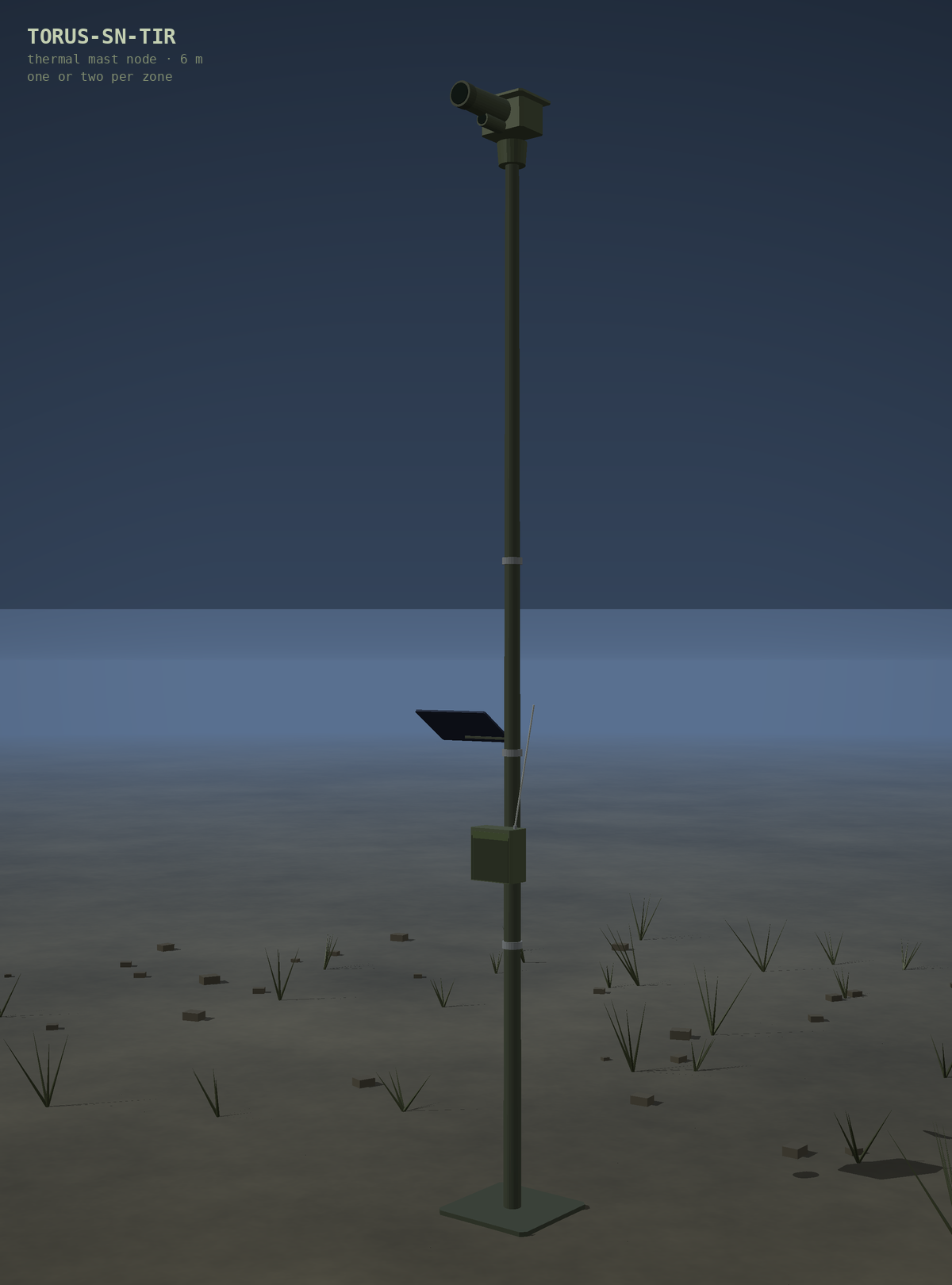
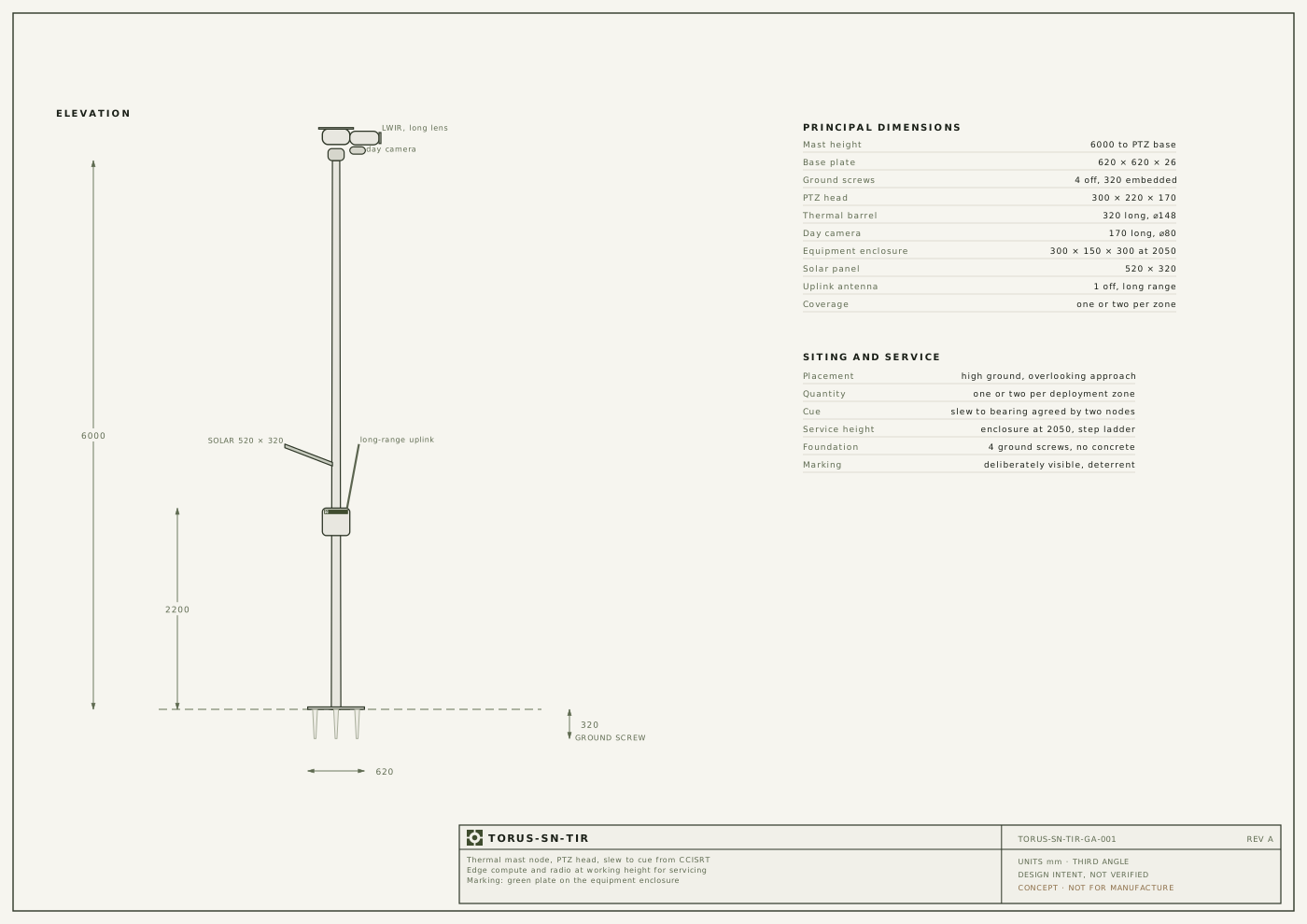
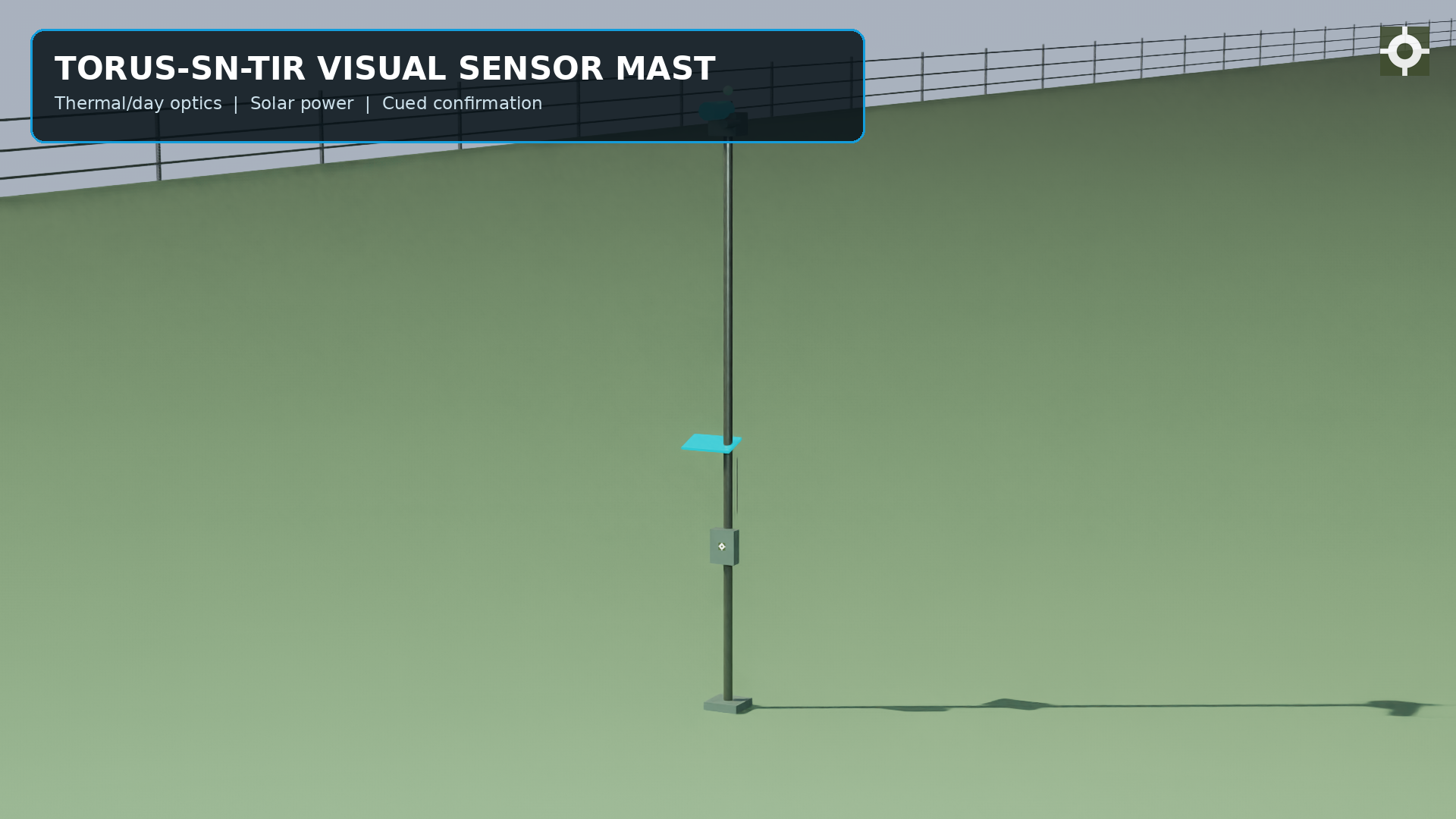
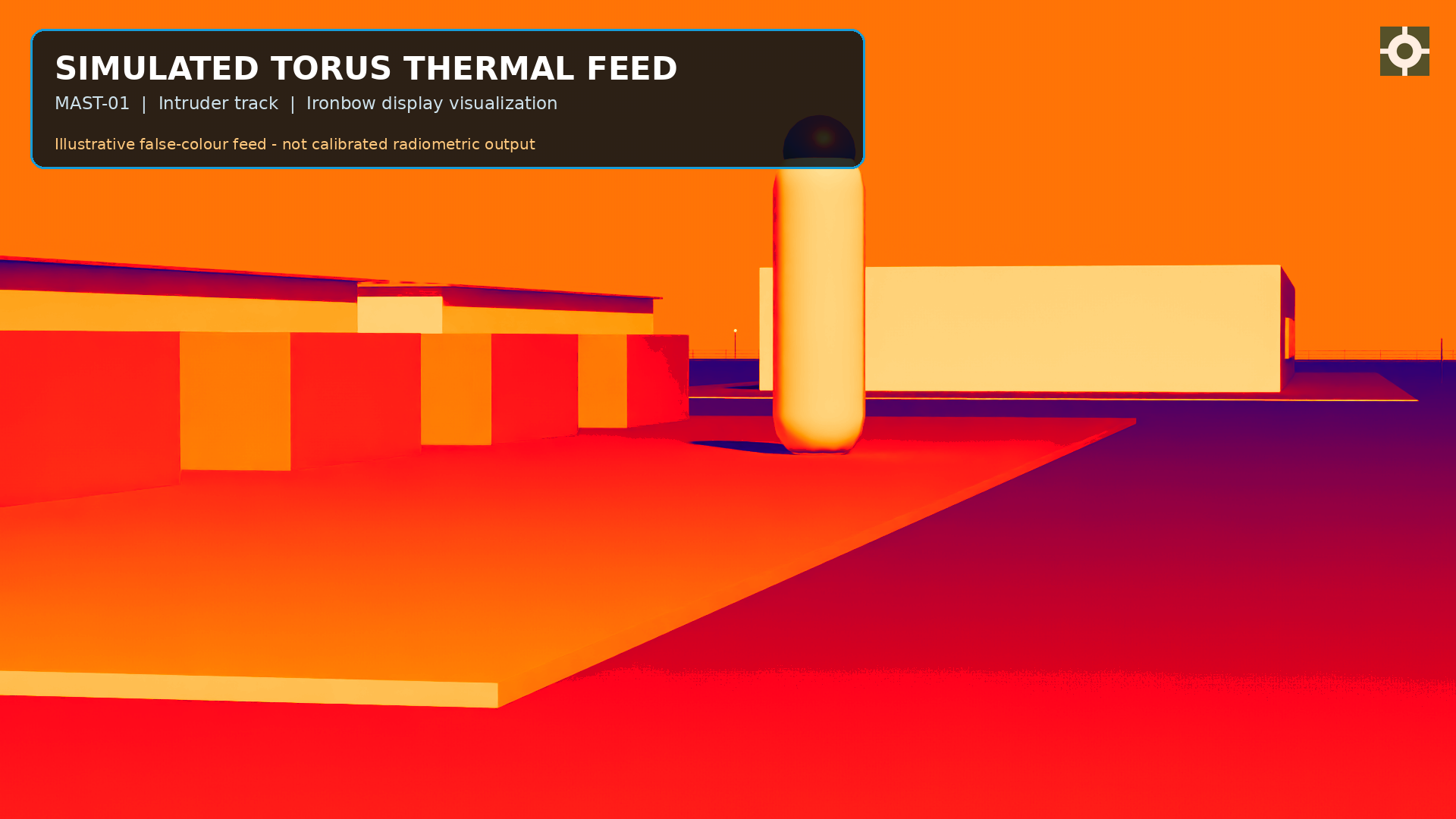
The visual mast extends the TORUS field into the visual domain. It carries thermal and day optics, LiDAR, radar panel, radios, and scenario-controlled thermal coverage in the simulation asset. In deployment it is cued by ground detections to identify and track at standoff, day or night.
Mechanical exchange
Download mast GLB Download mast STL
07 · Selection guidance
| If the segment needs... | Choose |
|---|---|
| Lowest cost, wide coverage, standard alarm profile | 1 · Fixed Wireless |
| Reconfigurable RF, congested spectrum, R&D | 2 · Programmable SDR |
| No RF emanation, maximum tamper resistance | 3 · Wired Optical |
| An authorised, validated physical response | 4 · Transducer |