TORUS-MEG facility aggregation gateway
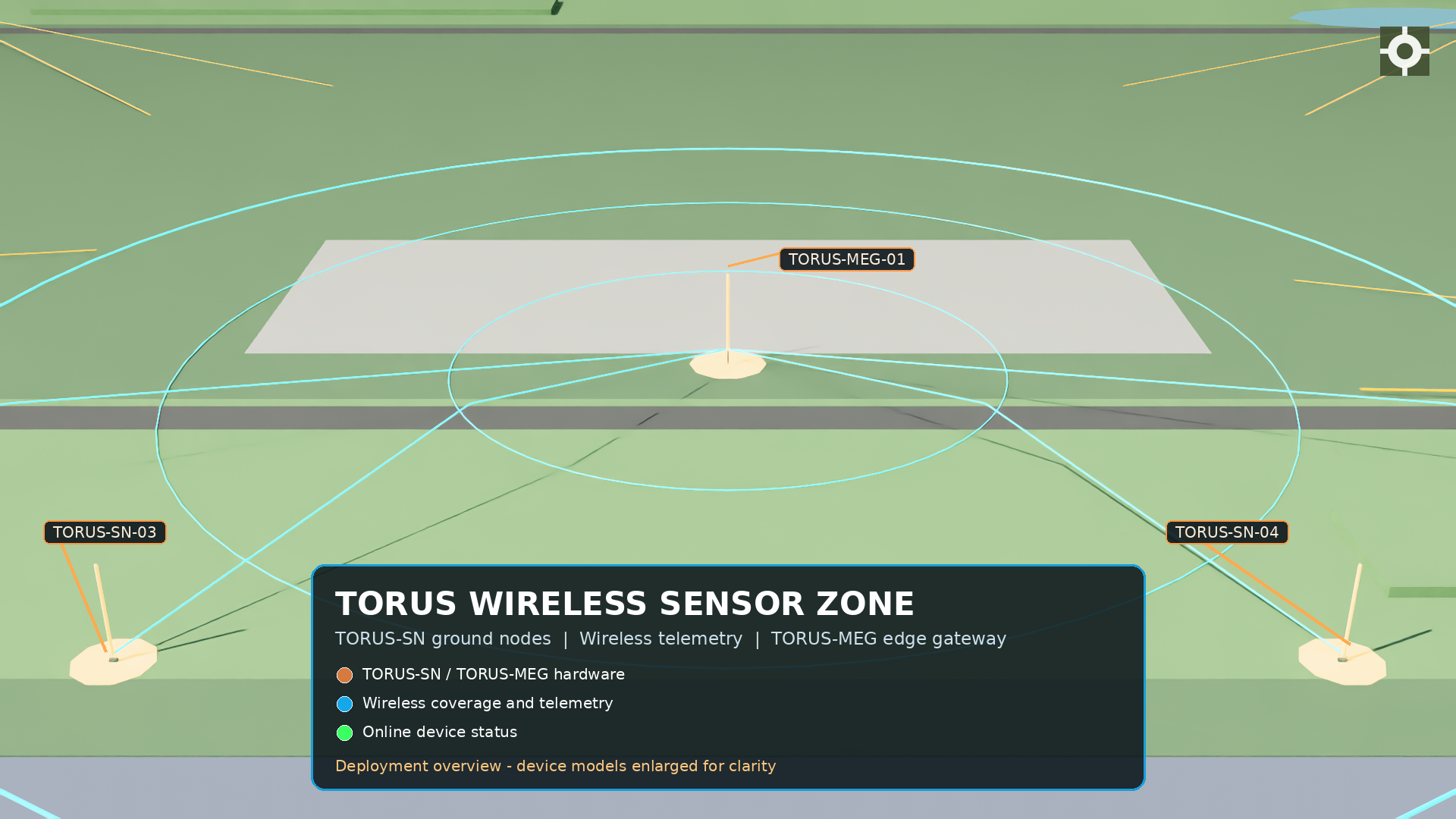
TORUS-MEG is the facility gateway of the TORUS platform. It receives LoRa uplinks from a ring of TORUS-SN ground nodes, timestamps and correlates their events against a disciplined clock, runs edge fusion and, where visual masts are attached, on-device inference, then forwards a prioritised event stream to the TORUS-CCISRT command plane over Ethernet, Wi-Fi, LTE/5G, satellite, or facility network backhaul.
CCISRT command layer Imagery and 3D library
01 · Gateway description
TORUS-MEG is designed for unattended campus perimeters, utility yards, and remote facility edges. A solar-and-battery power path, a wide-input DC front end, and a rugged sealed enclosure let a single MEG anchor a data center perimeter for months, storing and forwarding when the backhaul link is intermittent.
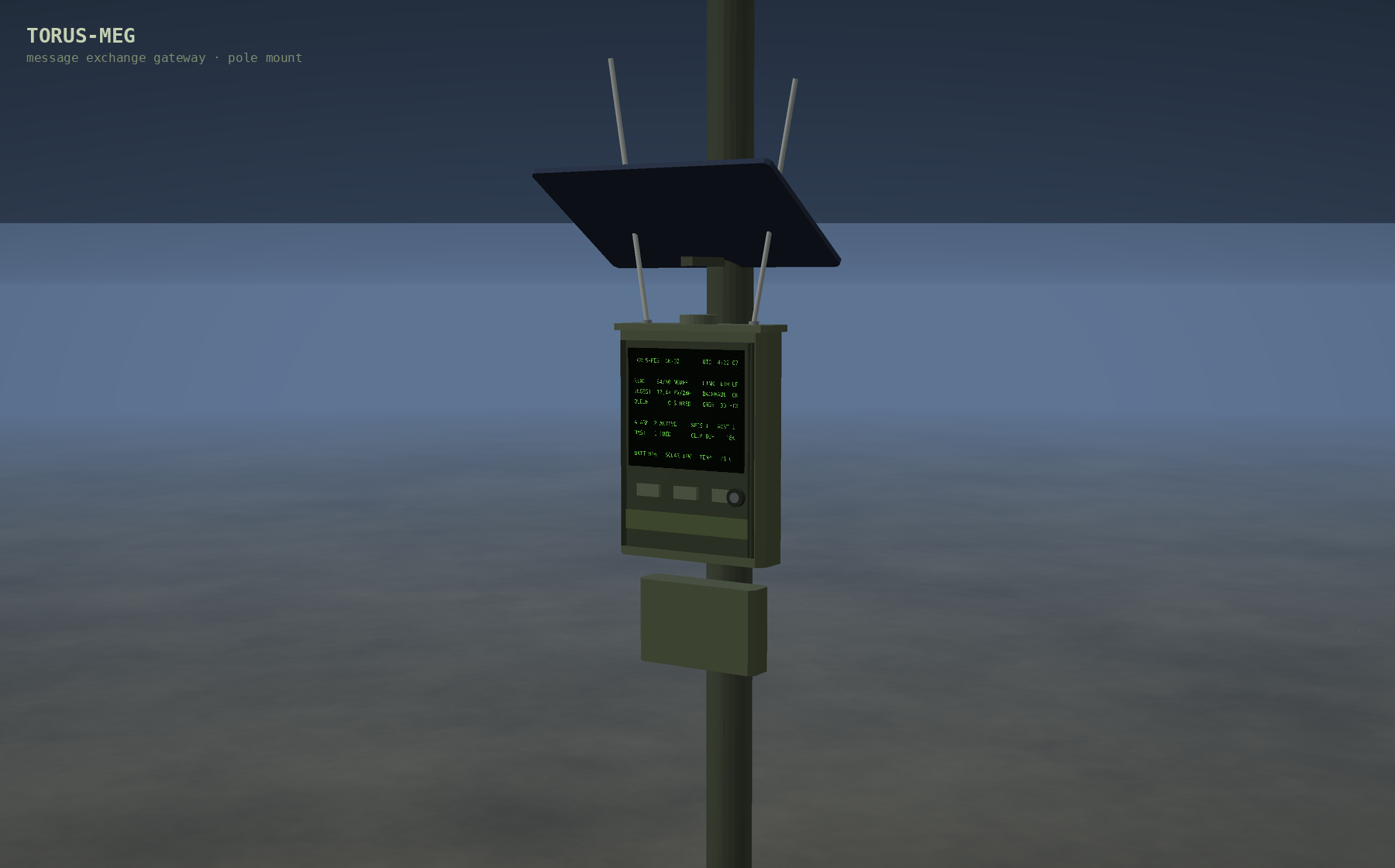
Features
- Multi-channel LoRa concentrator, 8-channel 433 MHz receive, so one gateway serves a large facility field of nodes concurrently.
- Edge compute, NVIDIA Jetson Orin-class module for sensor fusion and thermal or visual inference at the edge.
- Flexible backhaul, Gigabit Ethernet, Wi-Fi, LTE/5G cellular, or satellite, with automatic store-and-forward.
- Disciplined time, GNSS receiver provides UTC and node almanac and time sync.
- Off-grid power, solar MPPT plus LiFePO4 pack, wide-input DC, PoE or mains option.
- Secure facility integration, secure element or TPM, signed firmware, encrypted store-and-forward.
- Visual-mast ready, camera (GMSL/USB3) and LiDAR (Ethernet) interfaces for the visual domain.
- Rugged, sealed IP67 enclosure, wide operating temperature, pole or wall mount.
02 · RF ingest, fusion, and backhaul
| Block | Target behaviour |
|---|---|
| RF ingest | 8-channel LoRa concentrator, 433 MHz; SX1302 / SX1303 class; receives from the TORUS-SN facility ring. |
| Edge compute | NVIDIA Jetson Orin module for event fusion and correlation, thermal and visual inference, and NVMe event buffering. |
| Backhaul | Prioritised path to TORUS-CCISRT over Ethernet / Wi-Fi, LTE/5G modem, or satellite. |
| Time and sync | GNSS-disciplined clock for UTC timestamp, node time, and almanac. |
| Facility visual I/O | Mast sensor interfaces for GMSL / USB3 cameras and LiDAR over Ethernet. |
| Power | Off-grid path with solar MPPT + LiFePO4, wide-input DC, and PoE. |
03 · Preliminary specifications
| Parameter | Target | Notes |
|---|---|---|
| LoRa ingest | 8 channels, 433 MHz EU ISM | Concentrator-class receiver; serves tens of nodes per gateway. |
| Node capacity | Up to ~100 nodes per gateway | Duty-cycle and report-interval dependent. |
| Edge compute | NVIDIA Jetson Orin NX / Nano | Fusion plus optional visual inference; module choice by power budget. |
| Backhaul | Ethernet / Wi-Fi / LTE-5G / SATCOM | Prioritised store-and-forward on link loss; northbound API path to CCISRT integrations. |
| Time source | GNSS-disciplined, UTC | Also serves node time-sync and GNSS almanac. |
| Local storage | NVMe SSD, event and clip buffer | Sized for days of events and short thermal or video clips. |
| Power input | Solar MPPT + LiFePO4; 9-36 V DC; PoE+ | Off-grid autonomy target measured in months. |
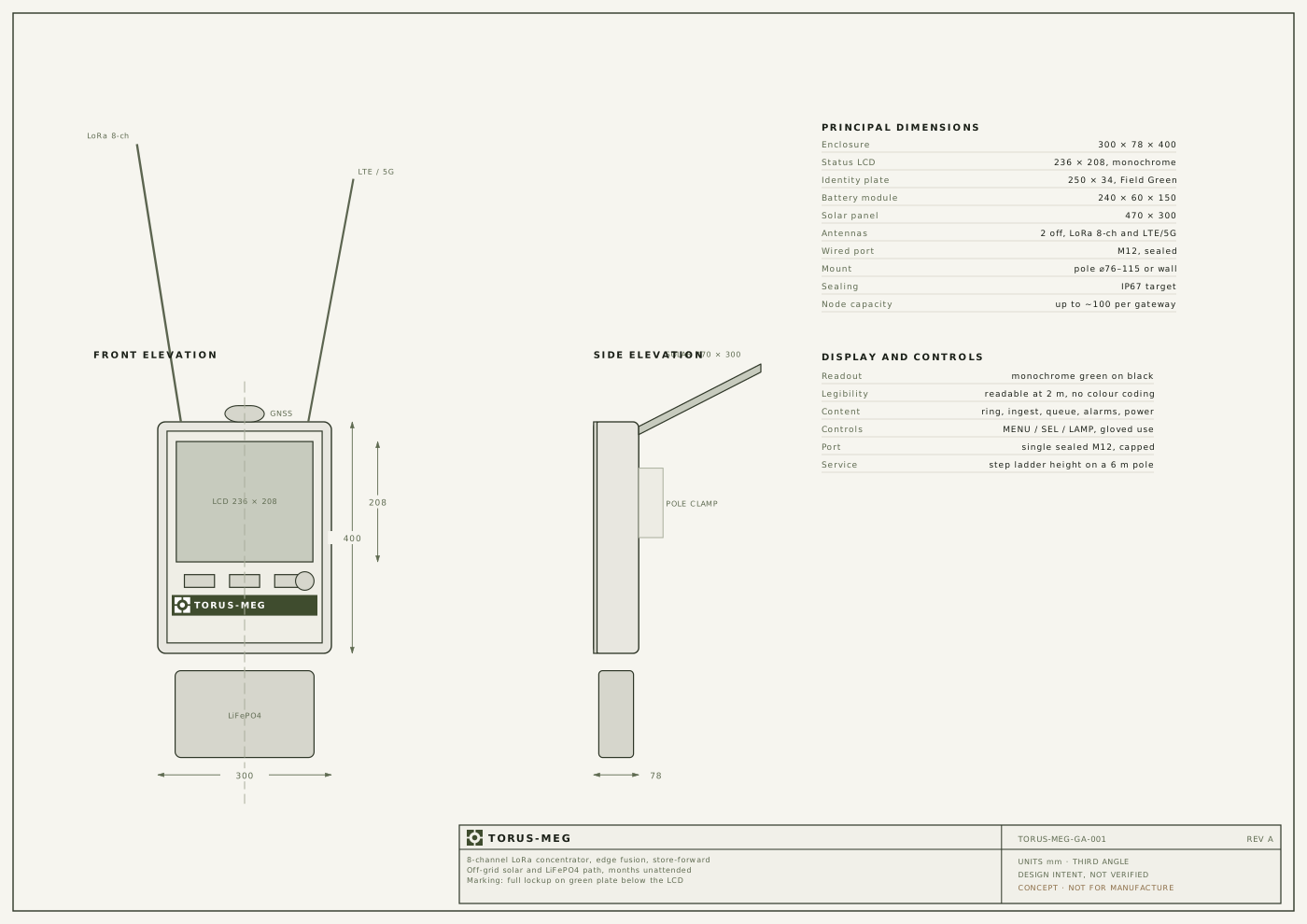
| Enclosure | IP67, pole or wall mount | Wide operating temperature, passive cooling. |
| Security | Secure element / TPM, signed firmware | Encrypted store-and-forward; optional on-prem-only mode. |
Design-study targets
TORUS-MEG is at concept and design-study stage. Values are design targets, not measurements, and component selections are candidates pending detailed design.
04 · Clustering and high availability
A single gateway anchors one facility ring. AI/HPC data center campuses can span distances larger than one gateway's radio reach, so TORUS-MEG is cluster aware: multiple gateways federate to extend and join sensor networks without a single point of failure.
| Capability | Behaviour |
|---|---|
| Chain / extend | Gateways relay along a corridor to reach node groups beyond one gateway's range, forming a linear chain. |
| Aggregate / join | Independent sensor networks federate into one facility operating picture; events keep their originating gatewayId. |
| High availability | Peer gateways form a cluster with leader election and health checks; on a node or link loss, a standby peer assumes the coverage. |
| Partition tolerance | A gateway that loses backhaul keeps sensing and stores events locally, then reconciles on rejoin. |
| Load sharing | Overlapping coverage is balanced across cluster members to spread ingest and inference load. |
Cluster design target
Clustering and HA algorithms (membership, leader election, and replication) are a design target for the detailed-design phase. The event contract already carries the gateway identity needed to federate cleanly.
05 · Mechanical enclosure and service access
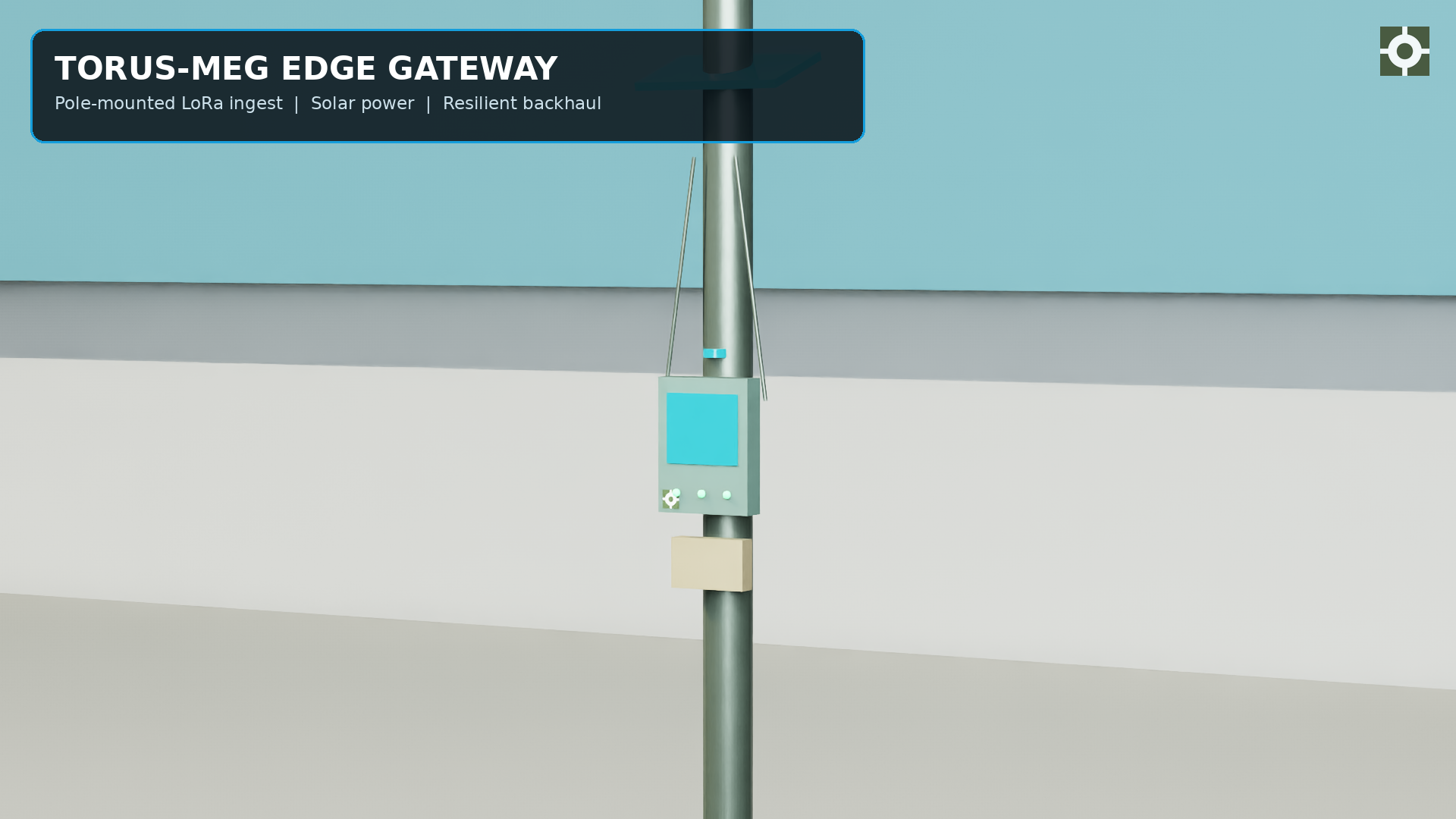
The gateway enclosure target is IP67 with pole or wall mounting, wide operating temperature, and passive cooling. The rugged sealed enclosure is part of the unattended campus-edge operating concept.
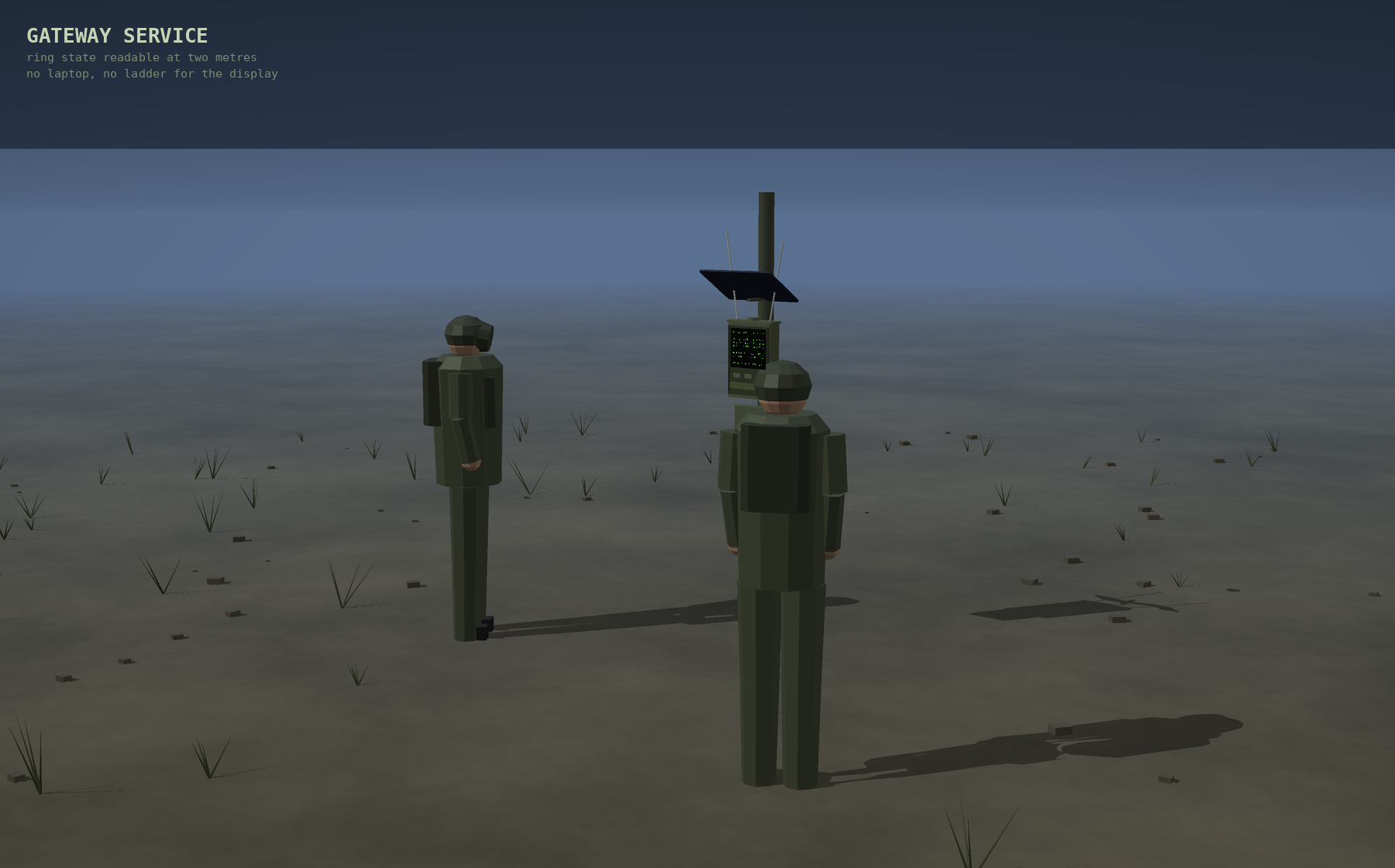
Download gateway GLB Download gateway STL
06 · Candidate components and open items
| Function | Candidate | Role |
|---|---|---|
| LoRa concentrator | Semtech SX1302 / SX1303, 8-channel | Multi-channel 433 MHz receive from the node ring. |
| Edge compute | NVIDIA Jetson Orin NX | Fusion, correlation, thermal and visual inference. |
| Cellular backhaul | Quectel RM5xx (5G) / EG25 (LTE) | WAN uplink where no fixed network exists. |
| GNSS timing | u-blox timing receiver | UTC discipline plus node almanac. |
| Power | MPPT charger + LiFePO4 pack | Off-grid solar autonomy. |
| Root of trust | TPM 2.0 / secure element | Signed firmware, key storage. |
Open items
- Edge module versus power. The Jetson Orin gives visual-domain inference headroom but raises the solar and battery budget. A lower-power SoM may be offered as a node-only-aggregation variant.
- Concentrator sourcing. The 433 MHz 8-channel concentrator front end and filtering are to be finalised for EU ISM duty-cycle rules.
- Backhaul matrix. Which WAN options ship as standard versus modular is a product decision driven by target deployments: campus perimeter, utility yard, or data hall approaches.
- Mesh option. Node-to-node relay for sites larger than a single gateway's RF reach is under evaluation.